Thursday, 28 November 2013

The canker: new revaluation frauds launched

If corruption and crime is allowed to fester unchecked, by its very nature it will spread. For years ASIC has allowed revaluation fraud and share ramping in the Australian market. As a result, new investment companies engaging in revaluation fraud are now sprouting like mushrooms on the ASX, with every failed and chronically loss-making entity imaginable starting anew as an LIC. After all, it is much easier to manufacture imaginary unrealized profit than it is to generate real cash profit. The new investment companies all follow the same modus operandi; they buy (often related party) assets, revalue these upward, ramp the investment company share price, and then issue shares to granny investors based on its great new "assets" and "profits".

Australasian Wealth Investments (AWK.AX) is a new listed investment scam created from the shell of MEF.AX, which in turn sprung from FAT.AX. During its phoenixing, it performed a series of sham transactions between related parties, and acquired a 50% stake in unlisted van Eyk research, which it can now revalue at will. AWK's most recently reported net tangible asset backing was $0.3753. AWK is issuing 38m shares at $0.3705, increasing shares outstanding by two thirds. AWK's share price was then ramped to $0.495 by the scheme's operators and accomplices, allowing them to book unrealized profits in excess of 30% in a matter of weeks.


Ramping AWK to $0.495 allows Contango Asset Management (CTN.AX) and Leyland Asset Management to fraudulently book unrealized profits in excess of 30% on their holdings of AWK. CTN pays real cash fees to its management based on such fraudulent unrealized "profits", and issues CTN shares to granny investors based on books with inflated assets. Of course, according to ASIC, when a revaluation fraud ramp occurs, it is not a ramp at all, but rather a magical market mystery.

Allied Consolidated (ABQ.AX) is another new revaluation fraud. Recently called Allied Brands, perennially loss-making ABQ is now changing name again, to Disruptive Investment Group, like children painting stripes on a car to make it go faster. ABQ has bought a failed internet business for $35,000, which it can revalue at will. At its general meeting ABQ resolved to issue 120,000,000 shares at $0.0025, issue 190,000,000 shares at $0.01, issue 60,000,000 options at $0.000025, and issue 20,000,000 shares to previous noteholders, with sundry allotments to directors. ABQ's price was then ramped to trade around $0.03.


The shenanigans at ABQ was too much even for the auditor to unflinchingly stomach, with the auditor making a "disclaimer of auditor's opinion" in the 2013 annual report and refusing to sign off that ABQ is compliant with the Corporations Act.


Meanwhile, ASIC is giving its guarantee that ABQ is not ramped and manipulated, just like it does for every single revaluation fraud. For if ABQ were ramped and manipulated, ASIC would have to do something about it.

Wednesday, 27 November 2013

A scam is but an investment with comprehensive management fees

US Masters Residential Property Fund (URF.AX) is a scam run by Dixon Advisory. The fund claims to invest in high-yielding American property, purportedly using collected rental income to pay steady high dividends to granny investors. In reality, URF is a ponzi that pays its dividends out of capital raisings. The operators of this scheme manipulate URF's share price while gutting the fund with various hidden fees and related party transactions. URF's half-year report for the six months to June 2013 brazenly describes ongoing securities fraud.

http://www.asx.com.au/asxpdf/20130828/pdf/42hzwfpnj35qh0.pdf

In the six months to June 2013, URF had investment property rental income of $4.4m, with rental expenses of $2.5m, for net rental income of $1.9m. From this $1.9m income, the scheme operators charged fees exceeding $10m:

  • Dixon  is entitled to an annual Responsible Entity Fee of 0.55% of the fund's gross asset value, charging $460,958 in HY13.
  • Dixon is entitled to an annual Investment Management Fee of 2% of the fund's gross asset value, charging $1,057,751 in HY13.
  • Dixon is entitled to a Leasing Fee of 3 months gross rent on new leases, charging $499,987 in HY13.
  • Dixon  is entitled to an Asset Acquisition Fee of 1.99% of the purchase price of assets acquired, charging $1,816,728 in HY13.
  • Dixon is entitled to a Structuring and Handling Fee of 2% of total funds raised, charging $2,947,774 in HY13.
  • Dixon is entitled to a Debt Arranging Fee of 2% of the gross amount of borrowings obtained, charging $614,872 in HY13.
  • Dixon is entitled to on-charge "administrative expenses", charging $3,042,028 in HY13.

These are but a subset of the fees charged by Dixon and related parties. Of these $10.4m in fees, only $1.7m was recognized as management fees in the profit & loss statement, with the rest obscured by fraudulent accounting and deceptively hidden in report footnotes. URF also paid out distributions to unitholders totalling $10.4m. All this was made possible by issuing shares worth $74m. What has just been described is not a viable business plan, it is a ponzi.

If URF shares were to trade freely they would have collapsed in value. Instead, Dixon and accomplices completely control URF's share price, and have ramped the price above reported NTA. URF does not trade at a "market" price, its price is fixed by the scheme operators. ASIC refuses to take any action, instead protecting the criminals. According to ASIC, the URF ramp is a magical market mystery, and not fraud. Dixon would never have been able to commit its crimes if not for the facilitation and legitimization from ASIC, its most valuable partner.


On 28 August 2013 a partner at Deloitte signed off on URF's half-year report, thereby becoming an accomplice to Dixon's securities fraud. From the accounts the auditor would have been perfectly aware of the fraudulence of the scheme, or should have been in any case, yet the scum still signed off on it. The partner did this safe in the knowledge he will never face prosecution for his role in this scam, never have to face any consequences for his crime.

Monday, 25 November 2013

Big fish eat little fish

The fair value of a listed investment company as a going concern is always lower than its liquidation value, since ongoing management costs burn a proportion of the cash generated by assets. This means that smaller LICs are vulnerable to predation by bigger LICs, by nature, if they allow their shares to trade at fair value. To avoid predation, LICs ramp their "market" prices above fair value, form crossholdings with accomplices, and entrench various poison pill measures designed to make it costly or impossible to wrench incumbent management away from the fee frenzy. Shrinking funds are especially susceptible to change of control, with the aggressor LIC not interested in the target's assets, but looking to take over the target's granny investors. A sharemarket listing provides legitimacy, allows the charade of a "market" price, and crucially, allows the investment company to issue inflated shares to granny investors.


The latest "new" Australian listed investment scam and revaluation fraud is Thorney Opportunities (TOP.AX), formerly Wentworth Holdings (WWM.AX), due to issue millions of shares at a purposefully inflated price. Thorney has ensconced its position with an openly exploitative management agreement that gives it 1.5% of gross assets annually and 20% of any increase in net asset value. The "independent expert" hired by Thorney calculated that the takeover would immediately destroy a quarter of shareholder value for non-associates ($0.525 before versus $0.409 after takeover). The "expert" then astoundingly concluded this was "not fair but reasonable", which seems like a perplexing conclusion, until you remember this is what the expert was paid to do.


Thorney and its criminal associates currently control the share price of WWM. WWM had an October 2013 net asset backing of $0.45, and is issuing millions of shares at $0.50, yet its current share price mysteriously has shot up to $0.68, in what ASIC guarantees to be a normal market movement and not a deliberate ramp. The true reason is not magic, however, it is fraud. The reason that WWM now trades at 50% above its latest reported NTA is that it has become a vehicle for securities fraud, with a completely manipulated "market" price.

Thursday, 21 November 2013

van Eyk funds "invest" in each other

van Eyk funds are engaged in revaluation fraud, using crossholdings and circular trading to artificially inflate assets. Listed van Eyk Blueprint Alternatives Plus (VBP.AX) feeds money into unlisted van Eyk funds that it can revalue at will. Various van Eyk funds then divert funds back into VBP. VBP is a circular investment scheme, a ponzi that pays dividends depending on how many units it can issue. In countries governed by the rule of law, VBP's circular investment scheme would already have led to fraud charges. ASIC has flatly refused to take any action whatsoever. van Eyk's fund empire deliberately overstates its assets by millions of dollars using internal crossholdings, by having its listed and unlisted funds fraudulently "invest" in each other.
 
According to its 2013 cash flow statement, VBP received $2.6m in dividends and interest from its related party "assets", with entirely reasonable and sustainable management expenses of $5.6m. VBP then paid $16m in distributions, made possible by $19m net inflows from unitholder applications.

http://www.asx.com.au/asxpdf/20130930/pdf/42jqdtc9kmrnw7.pdf

According to its annual report, VBP had total assets of $275m in 2013, $68m of which mysteriously consisted of receivables from brokers for securities sold, with $168m in the unlisted van Eyk Blueprint Alternatives Plus fund. These "assets" conspicuously fail to generate cashflows, which does not deter "investors" from buying VBP. The top 20 shareholders of VBP include funds such as van Eyk Blueprint Balance, van Eyk Blueprint High Growth and van Eyk Blueprint Capital Stable. This is open fraud, only possible because of ASIC's ongoing gross negligence and incompetence.

Aurora funds management is the responsible entity for VBP, acting as van Eyk's accomplice in this circular investment scam, but has lately started to distance itself from van Eyk. Following those noises, on 21 November Aurora tersely announced a meeting for unitholders to consider the replacement of Aurora as responsible entity.

http://www.asx.com.au/asxpdf/20131121/pdf/42l0lf8lc10sq0.pdf

Meanwhile, ASIC maintains its sphincter-like silence.

Wednesday, 20 November 2013

CDM comes bearing "bonus options"

The success of a listed investment company is predicated on its success at issuing shares. Operating performance is utterly irrelevant and can be misrepresented at will. ASIC doesn't even bother maintaining a semblance of regulation of NTA disclosures, allowing funds to materially overstate assets and commit revaluation fraud with related parties. Since share issuing and asset misrepresentation is the life-blood and raison d'ĂȘtre of fraudulent investment companies, they continually invent new ways to issue shares and misrepresent assets. Having already quadrupled shares outstanding in 2013, Cadence Capital (CDM.AX) announced it had "resolved" to issue "bonus options" to its granny investors in January 2014.

http://www.asx.com.au/asxpdf/20131114/pdf/42kvn7ngr1lcws.pdf

Any value the option will have to shareholders will be taken directly from the shareholders themselves. The bonus options are a "free" gift to shareholders, from shareholders, with zero net value for shareholders. Given administrative costs, the "bonus option" offer is objectively of net negative value to shareholders, a scheme only benefiting management hoping to issue shares, and a clear breach of  fiduciary duty. In net tangible asset disclosure documents, CDM now fraudulently claim these "bonus options" have a value of $0.075-$0.11 to shareholders, hoping to fool granny investors that expect such disclosure documents to be regulated. CDM management has conjured $0.075-$0.11 per share out of thin air, using the magic of accounting fraud.

http://www.asx.com.au/asxpdf/20131118/pdf/42kxzmp1nzqxqs.pdf

This net tangible asset disclosure is blatantly and intentionally fraudulent, and lodging it was a criminal act. It is an indictment on ASIC that it does absolutely nothing when funds deliberately falsify the most basic metric of all.

GFL, FSI and the crossholding buyback scam

Associated investment companies Global Masters Fund (GFL.AX) and Flagship Investments (FSI.AX) are part of a cartel engaged in revaluation fraud, in the form of the crossholding buyback scam. Like all investment companies, GFL and FSI pay exceedingly real fees to management based on unrealized profits, "profits" that in most cases are never subsequently realized. By using crossholdings and buybacks, related parties can artificially inflate assets, "profits" and fees.
 
A director's private company owns 56% of GFL and 28% of FSI. GFL has reported net assets of $10m, 28% of which was diverted to buy shares in FSI, distorting reported NTA and allowing directors to doubledip fees. After this "investment" by GFL, FSI ramped its illiquid share price with buybacks, creating illusory profits on GFLs holding. By funneling funds from GFL into FSI, in order to benefit themselves at the expense of small investors, the directors have breached their fiduciary duty. By deliberately misrepresenting their funds' assets and profits they have committed securities fraud.

FSI receives $1.5m dividends annually from its assets annually, with costs anywhere between 28% and 100% of cash inflow, mainly due to rapacious management fees. GFL has expenses in excess of revenues. The share prices of these companies have nevertheless been manipulated to par with NTA, far above fair value, with ASIC's blessing.


Monday, 18 November 2013

In remission: USH patiently waits

Directors of failed listed investment companies sometimes promise to "consider" giving back the funds they have gained control over and are taking fees out of. Unsurprisingly, such promises are never kept, as some great new "opportunity" always emerges, prompting the directors to instead raise even more capital. If the company fails so spectacularly that new sucker investors cannot be found, there are several options, the easiest of which is to just walk away from the smoldering wreck and start a new fund. Another option is to rename and recapitalize the company with accomplices, using fake transactions between the related parties to inflate the valuation of remaining assets, as in the case of Australasian Wealth Investments (AWK.AX). Sometimes failed investment companies are hibernated as the directors wait for the right time to resume share issuing. One such carbon-frozen company is U.S. Masters Holdings Limited (USH.AX).

USH is a dormant listed securities fraud incorporated in the British Virgin Islands. According to its latest NTA disclosure USH has net assets of $255,000, or $0.011 per share, largely held as cash. The last traded price for USH was $0.20, or 18 times current asset backing, and this is the price USH advertises as the current ASX "market" price on its website. USH has not traded on the ASX since 2012 and is currently bidless. In its 2013 annual report USH reports $25,000 in revenue and $729,000 in expenses, with cash decreasing by $607,000. Auditor Ernst & Young nevertheless unreservedly endorsed the annual report, with no going concern qualification. Because why not? It's not like they will be held to account by anyone.

Friday, 15 November 2013

Freelancer: priced for perversion

Freelancer (FLN.AX) listed on the ASX today, after an IPO of less than 7% of the company, with 30m shares offered at $0.50. Directors hold 87% of the 436m shares outstanding, with the top 20 shareholders owning 96%. Of the $15m cash raised, $1.25m was paid to a director's company for "various domain names" and $1m was spent in offer costs. $2.5m was doled out in non-recourse loans for directors and employees to buy employee shares. FLN opened at $2.50, pricing the company at $1.1bn, for a forecast 2013 price earnings multiple of 2,300. After peaking at $2.60 in the obligatory initial ramp, FLN's "market" price then fell as much as 45% in intraday trading, before closing at a $1.60.
 
These facts would seem enough to deter any sane person from investing in FLN. But in today's bizarre world this market perversion is regarded not only as entirely normal, but as a very positive start to a great investment for long term buy-and-hold granny investors. The broker of the IPO was KTM Capital, who previously had managed capital raisings for poisoned chalices Datadot (DDT.AX) and Antaria (ANO.AX). The share prices of DDT and ANO naturally follow the by-now familiar pattern of long term shareholder value destruction interspersed with temporary ramps.


In the case of Datadot, KTM got a wrist-slap from the Takeovers Panel for a fraudulent scheme to benefit insiders, with its conduct declared unacceptable and misleading. 

http://www.takeovers.gov.au/content/DisplayDoc.aspx?doc=reasons_for_decisions/2009/013.htm&doctype

So do as the co-opted media tells you, don't dig too deeply researching or thinking, just throw caution to the wind and buy all these great shares that are being shilled.

Thursday, 14 November 2013

CYA pays greenmail to WAM

Century Australia Investments (CYA.AX) announced a share buyback on 14 November, purportedly for "capital management" purposes. In reality, the buyback is greenmail to WAM, which built up a 21% holding in CYA and threatened to oust current management. CYA's porcine management announced the buyback to keep their snouts firmly in the fee trough. CYA's "market" price had been moved to par with NTA prior to the announcement, and fixed at $0.89.


In the preceding month WAM increased its CYA holding by close to a million shares, in preparation for demanding greenmail, so that it could sell back some of its CYA shares at the ramped price, and keep the rest of its holding valued at this artificial price. The communications between WAM and CYA regarding this scam is material information for their granny investors. When CYA's criminal management lied to its investors about the reason for the buyback, they committed securities fraud.

Listed investment companies are the Drosophila of financial fraud research, as they can be straightforwardly analyzed and valued. CYA holds listed assets with a current value of around $70m, or $0.89 per share. CYA collects interest and dividends of around $3m from these assets yearly, with around $0.8m in costs, or 27%. The fair value of CYA as a going concern is thus 73% of NTA, i.e. $0.65 per share, while its liquidation value is $0.89 per share. CYA promised years ago to liquidate the fund and return the money to investors, but never actually intended to, since that would stop the fee party.

The criminals running these companies know all this very well, but lie and dissemble, claiming that no matter the costs of an LIC, its ongoing fair value is at NTA or above. This is of course ridiculous, since quite obviously an LIC with lower costs would be worth more to an investor than an otherwise identical LIC with higher costs. CYA ridiculously claims costs of 1.1%, dividing expenses by outstanding assets, yielding a deliberately deceptive and useless metric favored by fund fraudsters. The entire business model of the LICs depends on such dissembling, as they could never function if they had to issue shares at fair value.

Tuesday, 12 November 2013

Aquaint and Mariner launch new listed securities fraud

Newly ASX-listed Aquaint Capital (AQU.AX) is a Singaporean-Malaysian "property seminar" company involved in various loans to, investments in and revaluations of related parties. AQU raised $3m from offering 5m shares at $0.60, constituting 5% of shares on issue, with issue costs absorbing $1m of funds raised. Not a single share of AQU has traded on the ASX since its November 11 listing, yet now AQU can claim a "market" value of $62m, with ASIC's stamp of approval. With a standing bid for $0.65, AQU can actually claim a "market" value of $68m, legitimized and validated by Australian regulators. This stamp of approval is invaluable for seeking new sucker investors.
 
AQU has acquired an Australian financial services licence from a Mariner subsidiary, and several of the Mariner crew are now discreetly involved with Aquaint. Given Mariner's consistent record in almost complete destruction of investor funds, with MCX losing 99.9% of its value and counting, their discretion is perhaps understandable. Perhaps Aquaint can now perform some related party transactions with MCX's newly "revalued" retirement home business.

AQU's assets comprise of a maze of failing property loans and investments with related parties in several different countries, that it can value largely at will. AQU's prospectus reveals that even using its own "valuation techniques", many of its "investments" have a current value below the loans attached to them, and have not yielded promised returns. But AQU is not about generating any actual returns from its investments, it is in the business of revaluing related party assets upward and issuing shares, taking fees at every level.

Shown below is the structure of AQU's Indian properties, sold to its property seminar punters and now packaged into AQU shares. Although AQU owns 82.9% of Bria East Asia Fund, it claims to not control it.


Monday, 11 November 2013

Clean Seas Tuna goes fishing for granny investor cash

Failed fish farmer Clean Seas Tuna (CSS.AX) is issuing yet more shares, following an endless series of capital injections and consistently loss-making operations. In the days prior to the announcement of its latest October capital raising, which CSS purports to base on a "market" price, CSS sharply ramped its share price with the aid of accomplices. CSS naturally pulled the usual "aw chucks no idea" routine when queried by ASX, as it always does. 

CSS is currently maintaining its price at $0.04 during the share offer, which entirely coincidentally would price the share raising at its maximum of $0.032. The capital raising squarely targets granny investors, offering a fraudulent 20% discount to the "market" price for investments up to $15,000. CSS will have 987,000,000 shares outstanding, and follows the standard pattern of long term decline interspersed with ramps. The corrupt directors of the CSS fiefdom also hire relatives and dish out extra "consulting" fees, as noblesse oblige.

Sunday, 10 November 2013

ASIC vouches that Goconnect is not ramped

Goconnect (GCN.AX) is a zany company with a billion shares outstanding and a consistent string of losses every year. Having formed a partnership with the Jackson family, GCN has abandoned any semblance of sanity. Its 2013 annual report humorously reports operating losses of $2m, net current liabilities of $4m, and $915 cash in the bank. GCN now plans to raise more money using the Jackson name, to build hotels and run reality shows in China.

http://www.asx.com.au/asxpdf/20131001/pdf/42jqzg949c22qq.pdf

GCN suddenly ramped its share price 250% in a few days in October, doing what it does best, namely issuing and ramping shares. GCN follows the familiar pattern of manipulated ASX companies, the interminable jolty downward ride. As always, ASIC pretends to notice none of this, and in effect fully supports GCN's and other companies' right to commit securities fraud, protecting the criminals by its refusal to take any action.


Saturday, 9 November 2013

Rey finds a "cornerstone investor"

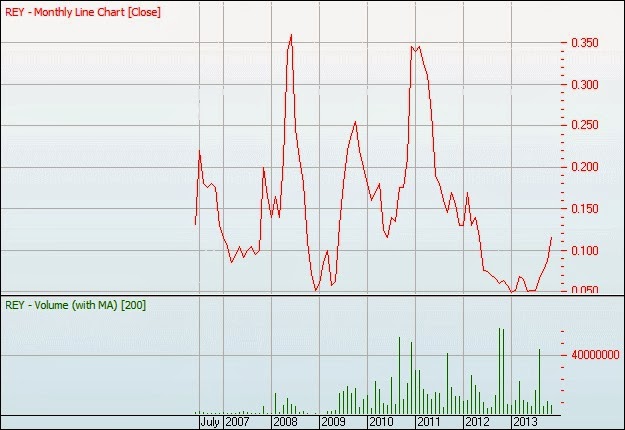
Rey Resources (REY.AX) is one of the major holdings of AFA. On 29 October 2013, REY issued $71m shares at around $0.06 to new "cornerstone investor" Crystal Yield Investments, further increasing the proportion of shares controlled by top twenty shareholders. Before taking up this 19.9% block of shares, Crystal Yield transferred its existing 9.8% ownership in Rey to parent company Ricky Holdings, because reasons. To celebrate, the price was ramped to $0.125 in early November, allowing the "cornerstone investor" an immediate unrealized "profit" in excess of $4m on its "investment", and prompting ASX to send one its price query charade letters. REY's share price, volatile even by mining exploration company standards, follows the standard pattern of long term shareholder value destruction interspersed with temporary ramps to benefit insiders.

Friday, 8 November 2013

Lion revalues related parties for a living

Lion Selection Group (LSX.AX) is an investment company that deliberately overstates its assets and issues shares to the public based on intentional misrepresentations. Its 2013 annual report claims $12m in listed investments and $33m in unlisted investments. Much of these funds are "invested" in related parties, allowing the criminals to double up their fees, with the assets freely "revalued" according to the fraudsters "opinions". LSX has revalued main unlisted investment One Asia from $0.40 to $0.75, and now carries its holding at $30m. Other related party investments include Asian Lion, African Lion 2 and African Lion 3.

http://www.asx.com.au/asxpdf/20131101/pdf/42kl426sh09k4g.pdf

To obscure and obfuscate, LSX continues to carry these related party "investments" as financial assets through profit and loss, denying it has the ability to control Asian Lion despite 63% ownership. Asian Lion, African Lion and Lion Selection Group are totally independent entities, you see. Completely unaligned.

Thursday, 7 November 2013

CAQ finds "sophisticated investors"

Cell Aquaculture (CAQ.AX) is a failed fish breeder turned listed securities fraud. In a bizarre July 2013 recapitalisation, CAQ issued 250,000,000 shares at $0.01 to the public, and 100,000,000 shares at $0.005 to "sophisticated investors", bringing total number of issued shares to 374,000,000. At reinstatement of trading the magically transformed company traded at $0.02. Then in October CAQ started to be ramped, in what ASIC regards to be a perfectly normal market movement, going to $0.098 in early November.


CIN borrows from CIN to buy some CIN shares

Carlton Investments (CIN.AX) and Amalgamated Holdings (AHD.AX) have built up crossholdings approaching a billion dollars, separating ownership and control, allowing the companies to manipulate their own share prices and present deliberately falsified annual reports. CIN and associates hold 35% of AHD shares, while AHD and associates hold 61% of CIN shares. The combined crossholding has a nominal value of $868m, constituting 44% of CIN's and AHD's combined market cap. CIN and AHD also have substantial crossholdings with fellow criminal investment companies AFI, MLT, ARG and WAM.

http://www.asx.com.au/asxpdf/20130912/pdf/42jb3qsl6g9mr8.pdf

Buried in the notes of its 2013 annual report, with next to no detail provided, CIN discloses inter-company loans totalling $158m, up from $148m in 2012, that it eliminates upon consolidation. These $158m loans are apparently of zero interest to an investor wishing to build a fair view of the company. Some of the loans are taken out by Eneber, the controlled investment vehicle that owns much of CIN. So CIN has taken out a loan from itself, and used the proceeds to buy itself.

Wednesday, 6 November 2013

CVC Limited revalues itself upward

CVC Limited (CVC.AX) uses crossholdings, related party transactions, revaluations, "loans" and write-offs for the purpose of securities fraud. CVC ramps the companies it has significant interests in, creating artificial unrealized profits that never translate to cash flows. Directors of this scheme were recently arrested for tax fraud. Ripping off granny investors is fine, but don't dare deprive the taxman of his cut of the loot, or you might actually be arrested.

CVC's recently released annual report is a marvel of creativity, giving almost no indication of what the company actually does, instead showing a fudged profit driven by assorted revaluations ($21m), recoveries ($11m), impairments ($12m) and related party transactions. The company has $13m of loans to related parties that are periodically written off, and books $6.7m simply as "All other expenses". CVC reports $88m sales of goods, with no further details whatsoever provided. 

http://www.asx.com.au/asxpdf/20131028/pdf/42kc7pv51x8pdh.pdf

CVC holds a number of listed and unlisted investments that it revalues at will. In its annual report, CVC notes that several of its listed investments are too illiquid for market prices to be useful for valuation, and then proceeds to use them anyway. CVC's portfolio of lossmaking companies include BNO.AX, VLW.AX, VSC.AX, LNR.AX, RES.AX, CYC.AX, MNZ.AX and BRU.AX. These have been ramped significantly since July 2013, which will allow CVC to claim further imaginary profits.

Tuesday, 5 November 2013

Centuria funds "invest" in each other

Centuria Capital (CNI.AX) runs a crossholding scheme whereby a web of subsidiary funds hold stakes in each other, performing circular transactions deliberately creating falsified NTAs and results. The footnotes to the CNI annual report reveals dozens of festering CNI funds "investing in" and "lending to" each other.

CNI holds 2.1m units of the Centuria Direct Property Fund (CDPF), while subsidiaries Centuria Income Accumulation Fund (CIAF) holds 6.9m units and Centuria Growth Bond Fund (CGBF) holds 9.8m units. CGBF holds 1.7m units in Centuria 10 Spring St Fund (CSSF), 11.1m units in Centuria Diversified Property Fund (CDVPF), and 1.0m units in Centuria 8 Australia Avenue Fund (CAAF). Centuria Property Funds (CPF) holds 2.9m units in CSSF, Centuria Balanced Fund (CBF) holds 0.7m units in CSSF, Centuria High Growth Fund (CHGF) holds 0.7m units in CSSF, Australian Property and Mortgage Bond Fund (APMBF) holds 1.1m units in CSSF. CNI has "invested" $5.8m in CIAF, which in turn has "lent" $5.7m to Strategic Property Holdings (SPH) and $8.9m to Centuria 4-8 Woodville Street Fund (CWSF). CNI has a $1.0m receivable from CDVPF, $1.2m from CBGF1, and $0.3m from SPH. CPF has a $1.9m receivable from CSSF. CGBF bought 3.1m units in Centuria 131-139 Greenfell Street Fund (CGSF) at a "market" price from a related party.

http://www.asx.com.au/asxpdf/20131028/pdf/42kcsnx1fkxrfw.pdf

ASIC of course does absolutely nothing to stop crossholding and related party transaction fraud, provided the right forms have been filled in, but instead legitimizes and protects the criminals.

Monday, 4 November 2013

Mariner robs the ancients

Listed securities fraud Mariner Corporation (MCX.AX) now professes to be in the retirement home business. Having purchased an unfinished project from receivers for $6m of borrowed money in September, a month later MCX announced it had revalued the project at $13m, based on directors' "belief" and "independent valuation". Hey presto, an immediate imaginary $7m profit.

http://www.asx.com.au/asxpdf/20131025/pdf/42kbb9vhwh4rk2.pdf

On the 31st October, MCX was ramped 43%, closing at $0.15. In total 50,882 shares were traded on the ASX on that day, which is many times the average daily MCX volume, but still only corresponds to a few thousand dollars. According to the customary ASX price query charade, the ramp was a normal "market" movement, with this notion fully endorsed by ASIC.

http://www.asx.com.au/asxpdf/20131101/pdf/42kkxfrsmcdvg9.pdf

MCX has been ramped 700% since September on next to no volume. The ramp allows associated listed investment company Lemarne (LMC.AX) to book its recently granted holding in MCX at the artificial value, based on which it can issue shares to granny investors, all with ASIC's stamp of approval. Perhaps Sydney Morning Herald can then run a column shilling MCX and LMC, advising investors not to "dig too deeply" researching the scam, but to "throw caution to the wind" and "enjoy the ride".

Friday, 1 November 2013

Dixon Advisory's funds are ponzi schemes

Dixon Advisory & Superannuation Services preys on granny investors using a suite of scam investments that pay returns out of capital raisings. The Asian Masters Fund (AUF.AX) pays dividends and performs buybacks out of share issues, using the yield to attract more granny investors to issue shares to. The AUF share price has been ramped significantly above asset backing despite the company's perennial losses, rapacious management fees and heavily negative operational cashflow. In 2013 AUF had negative operational cashflow of $1.6m, down from negative $1.5m in 2012, yet paid out $2m in dividends and $24m in buybacks. This was made possible by issuing $28m worth of shares in 2012 (and even more shares in 2011). The operators of this ponzi scheme netted a cut of around $4m over the last two years, money stolen from granny investors, as shown in its annual report.

http://www.asx.com.au/asxpdf/20130927/pdf/42jnmfy0gfs2j3.pdf 

Next, AUF will issue shares at the artificial price, marketing its fraudulent returns with ASIC's blessing. Dixon operates this scam under the protection of ASIC. Since ASIC has given its approval to the scam, no financial adviser could be faulted for recommending it, no journalist could be scolded for shilling it, and the criminals are in effect untouchable.

Thursday, 31 October 2013

ASIC allows funds to fix their share price at above NTA

The Australian Governance Masters Index Fund (AQF.AX) is a listed investment scam run by the fraudsters from Dixon Advisory & Superannuation Services. With revolting hypocrisy, AQF ostensibly invests in the "best governed" ASX100 companies, aiming to hold between 75-85% of the index. This zeal for governance does not extend to the company itself. AQF is run by criminals that deliberately manipulate the company's illiquid shares. With ASIC's tacit approval, AQF sets its own share price at higher than asset backing, partly by performing buybacks. 

This fixed "market" price is of course only sustainable if AQF's granny investors do not actually try to sell at the fake price. In case of sustained net investor outflows, the company could at most support its share price at actual NTA (which is of course post-tax, whatever the criminals may profess to "believe"). AQF also issues shares to investors while making the fraudulent representation that it trades at a "market" price, whereas in reality AQF sets its own price. There is currently one buyer and one seller for AQF, namely AQF itself.

AQF does not even disclose actual NTA in its weekly disclosure documents, instead only reporting "pre-tax" NTA (i.e. an imaginary NTA if taxes were abolished). The criminals then set the share price floor at this inflated figure. Currently, AQF's "pre-tax" NTA is $1.90, with its actual NTA estimated at several percent less.

http://www.asx.com.au/asxpdf/20131030/pdf/42kfv3p1mhhpl1.pdf

That ASIC allows AQF to openly ramp its share price above its asset backing is an absolute disgrace, proof positive that the regulator is completely ineffectual against even the most blatant fraud. If criminal directors just claim to "believe" they are acting for the good of shareholders, and fill out the forms, they are allowed to openly run a ponzi scheme.

Wednesday, 30 October 2013

Argo Investments intentionally falsifies its NTA

Argo Investments (ARG.AX) has repeatedly committed securities fraud by reporting inflated NTA and claiming that its shares trade at a discount to NTA. ARG has admitted to making such representations to financial advisers, deceiving clients into feeding money into a scheme actually priced at a significant premium to NTA. ARG currently inflates its reported NTA by 14% by using "pre-tax" estimates, based on the "opinion" that they can exclude taxes due on unrealized capital gains, yet still include the full effect of the gains themselves, effectively reporting a hypothetical NTA in a world where taxes have been abolished.

But this is not a matter of opinion. Even if criminals are of the "opinion" that one plus one equals three, that does not them the right to use such maths in their books. This is fraud, regardless of the criminals' "opinion". Net means net, i.e. after costs such as tax, regardless of what the fraudsters opine. The value of something is what you can sell it for, not what you can sell it for assuming there were no such thing as taxes. ARG goes one step further than other criminal LICs by not even including the words "pre-tax" in their NTA disclosure documents, which is blatantly illegal, as it gives the impression they are disclosing their actual NTA when they are not. ASIC does nothing about this deliberate recurring misrepresentation.

http://www.asx.com.au/asxpdf/20131004/pdf/42jv87rm1wpjqb.pdf

ASIC could just mandate that funds have to report their actual NTA and are forbidden to use deliberately deceptive metrics such as "pre-tax NTA", with or without "explanatory" footnotes. But ASIC is completely useless, and makes no attempt at ensuring disclosure is accurate or presents a fair view, merely being concerned with quantity and encouraging frequent fraudulent disclosure. Australian investors can't even expect something as fundamental as an accurate and unskewed view of the value of a fund's assets in disclosure documents. Instead investors are given director's "opinions" of what the criminals think the assets should be valued at.

The idea that net assets can ignore taxes is ludicrous, it has absolutely no basis in reality. Neither does it make any sense to doublecount upcoming dividends as a receivable in net assets. But since criminals are freely allowed to define their own reality in Australia, anything goes. Over the last year more and more funds have been purposefully ramped above NTA, so that a fraudulent profit from subsequent share issuing to scammed granny investors can be achieved.

Tuesday, 29 October 2013

Throwing caution to the wind

ASF Group (AFA.AX) describes itself as involved in the "identification, incubation and realisation of embryonic opportunities", claiming business activities in the fields of tourism, commodities trading, property, travel, energy, resources, investments and financial services, and as a "creator and facilitator of two-way cross-border investments, trade and technology transfers". In reality, AFA is simply another fraudulent listed investment company. In its bizarre FY13 annual report, AFA reported a loss of $30.5m based on revenues of $1.7m. Net assets amounted to $1.2m, down from $29.2m in FY12. The "market" still mysteriously values AFA at $56m.

A year ago, AFA was touted by the Sydney Morning Herald small cap shill, in an Under The Radar column straight out of The Onion. The shill admitted to having no idea how the company purportedly made money. The slimy shill then recommended small investors "throwing caution to the wind - rather than digging too deeply into the detail." The small cap shill then praised how AFA's chairman once "won a singing contest" and lauded AFA for having "very few costs".

http://www.smh.com.au/business/under-the-radar/a-small-cap-in-the-dragons-saddle-20120829-24zoq.html

How much the shill was bribed for this insane column, if anything, is of course unclear. Lacking the slightest shred of integrity, it stands to reason the shill would sell himself for next to nothing. If he wasn't bribed for this column, in some ways that makes his conduct even more pathetic.

AFA engages in ramping, revaluation and reclassification of assets, as well as various related party transactions and loans. AFA has never had actual positive cash flows, it solely functions as a vehicle for securities fraud. With ASIC's blessing, AFA simultaneously issues and buys back its shares, allowing it to control its own "market" price. According to ASIC, such manipulation is just a great feature of the "market".

Monday, 28 October 2013

Just shilling and enjoying the ride

It is standard business practice for Australian investment companies to ramp the share prices of controlled holdings, with the fraudulent "market prices" giving rise to unrealized profits. Ramped assets are packaged in asset backed securities and dumped on granny investors as companies issue shares. The result is long term shareholder value destruction, interspersed with temporary ramps to benefit insiders. Associated shills play a key part in this securities fraud, with the Sydney Morning Herald even having a dedicated column for shilling ramped small caps. The Under The Radar column features a particularly vile individual shilling stocks he is perfectly aware are manipulated, with his latest column advocating the exponentially ramped FNP.


The column touting FNP makes for surreal reading.


The shill freely admits that the recent exponential ramp of FNP "defies logic". He acknowledges that FNP is trading at 205 times its FY13 net profit before abnormals. The shill is aware that a single shareholder holds 60% of FNP, that the top twenty shareholders own 90% of common shares and 98% of convertibles. The shill claims to "not understand" why the "market" suddenly values FNP at half a billion dollars. Yet this is apparently of no concern. The shill recommends granny investors keep holding this manipulated stock and just "enjoy the ride".

Of course, were the shill to admit that FNP is ramped, he would be confessing to being an accomplice to securities fraud. So lo and behold, the shill feigns complete innocence. The Under The Radar shill has ties to criminal listed investment companies and has repeatedly aided them in securities fraud. MIR holds a major stake in FNP, and may have been the source for the shill's anonymous quotes in the article. The shill also recommended investors "enjoy the ride" when CTN ramped BCC.


For reference, here is the ride that the shill thinks investors are "enjoying" at BCC, showing the now familiar pattern of long term shareholder value destruction interspersed with ramps to benefit insiders:


When one day the shill shuffles off this mortal coil, leaving the world an unequivocally better place, hopefully he will enjoy his well-deserved ride straight to hell.

Friday, 25 October 2013

Taxing times in Bermuda

As part of its zero enforcement policy, ASIC takes no action against companies engaging in share manipulation and sham transactions, as long as the proper forms are filled out. Not only can listed investment companies avoid tax through correctly structured international sham transactions and "loans" between related parties, they can actually claim a tax benefit. As a recent example, ZER and Utilico Investments engaged in a series of related party transactions, write-offs and loans, resulting in an annual report that best can be described as comical.

Domiciled and tax-exempt in the Bermudas, ZER was listed on the ASX in June 2013 and recently submitted its FY13 annual report, reporting an immediate loss of $9,338,686 and a tax benefit of $546,439 from the R&D tax offset.

http://www.asx.com.au/asxpdf/20131018/pdf/42k3xct105hptw.pdf

ZER had revenues of $310,000 from interest and foreign currency gains in FY13, with expenses and write-offs totaling $9,615,996. The company also took out a "loan" of $4,577,000 from Utilico Investments, resulting in current liabilities twice that of current assets. Nevertheless, KPMG in South Africa signed off on the annual report unreservedly. This mysterious business plan apparently appeals to investors, as the "market price" of ZER has risen 20% since listing. Of course, this may have been helped by the fact that the top twenty shareholders own 95.26% of the company, with the aforementioned Utilico Investments holding a 77.35% stake. No matter. According to ASIC, ZER trades at a market price and belongs on the ASX with its brethren fraudulent investment companies.

The charade: A guide to answering ASX price queries

Australian regulators have a zero enforcement policy regarding share price manipulation, with ASIC never intervening against share price ramps. The only consequence for companies deliberately ramping their share price is a potential ASX price query, a form letter asking if the company is aware of any undisclosed information that could explain recent price movements. Every single time this occurs, the company in question then replies that it has no idea whatsoever what could have caused the price movement. And that's it. Since all replies to ASX queries are essentially identical, the whole exercise is just a charade, with absolutely no point. Included below is a standard response that ASX instead could complete and send to itself. This would save everyone time and have the same (non-existent) benefit as the current charade.
Dear ASX, 
Thank you for your letter dated [insert date] regarding a change in volume and price of shares in [insert company name]. In reply to your questions:
1. The company is not aware of any information concerning it that has not been announced, which if known could be an explanation for recent trading in the company's securities.
2. Not applicable.
3. No.
4. The company confirms it is in compliance with the listing rules and in particular with listing rule 3.1. 
Yours faithfully, [insert name].
This form letter could be used by ASX in every instance. MNW provides a nice example of how this works. Ramped 1000% in three months, MNW issued shares and options starting at $0.10 to accomplices. These accomplices then ramped the share price above $0.40. The management of MNW not only knew the reason for the ramp, but had engineered it themselves, yet when queried by ASX supplied the following response:

http://www.asx.com.au/asxpdf/20131004/pdf/42jtqrs5vk2y3j.pdf

Next time, Elvis could just fill out the standard response and send it to himself, with identical end result.

Wednesday, 24 July 2013

Citigroup Australia involved in multibillion dollar fraud

Citigroup has created products specifically for the Australian Foundation Investment Company scam, designing the products to the specifications of the criminals, fully aware that the products were to be used for securities fraud. Citigroup provides leverage for the scam, further deferring liabilities of these already catastrophically underfunded schemes, increasing losses to granny investors that already run into the billions. Citigroup has created a series of warrants for these companies, while being aware of their deliberate overvaluations, accounting fraud and ramped share prices. These warrants are not widely advertised by Citigroup, which understandably does not flaunt its involvement in multibillion dollar asset-backed securities fraud.

Used by the criminals and pushed by associated advisors, these products are often sold on the basis of ongoing tax minimization.

http://www.asx.com.au/asx/markets/priceLookup.do?by=asxCodes&asxCodes=afijoh
http://www.asx.com.au/asx/markets/priceLookup.do?by=asxCodes&asxCodes=afiszb
http://www.asx.com.au/asx/markets/priceLookup.do?by=asxCodes&asxCodes=djwjoh
http://www.asx.com.au/asx/markets/priceLookup.do?by=asxCodes&asxCodes=mltjoh

AFI and its associate criminal listed investment companies have fraudulently inflated their NTAs with ramped assets, crossholdings and accounting fraud doublecounting investments. They have then manipulated their share prices to up to 30% over even these fraudulent NTAs, issuing millions of shares to granny investors at the purposefully inflated prices. Pension savers think that they can cash out at the prevalent 'market' price at any time, while the scam in aggregate actually is underfunded by billions of dollars, granny investor funds that are lost forever, something which will be discovered the moment people try to cash out. The criminal LICs rationalize this by predicting eternal fund inflows, in which scenario their schemes actually do work, like any ponzi.

Citigroup has helped with this fraud of asset-backed securities, knowing the securities were fraudulent, but still designing and selling derivatives based on them, adding a derivatives bubble to an existing ponzi. Citigroup obviously is entirely fearless of the prospect of multibillion class action lawsuits when grannies find a quarter of their funds in these schemes were missing the entire time. As a mathematical fact, the AFI/DJW/MLT scam depends on continued net fund inflows, from granny suckers or debt, otherwise the price could not be held manipulated 30% above NTA. The question is how far this goes up Citigroup management. Is it only Citigroup Australia which is complicit, or is the head office aware of this securities fraud?

Tuesday, 23 July 2013

The precedent: 'Invalid' section 249D notices

Given the vast value of control in the Australian listed investment company sector, incumbents have strong incentives to do whatever necessary to avert attempts to wrest control away, including openly illegal acts (usually lacking repercussions anyway). BCC and ELI were among the pioneers of simply refusing lawful requests under section 249D of the Corporations Act. On 13 March 2013 ELI disclosed it had received a s249D notice requesting a general meeting. On 2 April ELI claimed the request was 'invalid', for no apparent reason, and that ELI directors therefore were above following the law and would not comply. 

ELI directors refusal to comply with the Corporations Act was seemingly completely groundless, but since they could do so to great advantage and without repercussion, and at the very least delay the request, they did. Section 249D seems simple enough and would not at first glance be expected to have much leeway for creative interpretation:


But never underestimate the creativity of desperate criminals. At the time, ELI's openly unlawful behaviour was expected to set a precedent for this method of retaining control of other peoples' money:


As expected, other directors receiving s249D notices have started claiming they are 'invalid'. The latest example is Liberty Resources (LBY). On 23 July LBY claimed the s249D notice they had received was 'invalid', due to unspecified 'irregularites, inconsistencies and uncertainties', and that directors thus would ignore this 'invalid' request. What this means is, they make the rules.

Losing control: ELI pays greenmail to WAM

If an LIC's management is able to abscond with 20% of the cash inflows generated by the LIC's assets, year after year, the value of control to management is 20% of the value of held assets (value which is transferred directly from shareholders). The overall value of control in the Australian LIC sector thus amounts to several billion dollars. The fraudulent ecosystem of the LICs teems with activity around the central issue of control. LIC managers predate other LICs by acquisition, and defend themselves by various poison pills. This criminal underworld is both cooperative and ruthlessly competitive. ELI recently experienced this first hand, as WAM bought a substantial stake, threatened to wind up the company to realize the gap to NTA, and demanded greenmail. 

Like all LICs, ELI is worth more wound up than as a going concern, due to management fees. WAM successfully extracted greenmail from ELI, with ELI management offering a selective cash buyout, hoping to retain unwitting granny investors to continue leeching off in an unlisted vehicle. The 'reorganization' proposed by ELI on 19 July also included a $464,000 fee from shareholders to management as compensation for loss of control.
So everyone wins, except for shareholders that is, but that's the entire point of these schemes; transferring wealth from granny investors to management, from fools to criminals.

WAM executed the same strategy with SGI, buying a stake at sub-NTA and then negotiating a deal with the incumbent criminals. In other cases WAM has not been as successful in extracting greenmail. When it tried to make a move on MEF it was outsmarted, as MEF management performed a series of blocking sham transactions with Aurora. WAM also had a longrunning lovers' tiff with the Contango crew. These disagreements, as well as ELI's disagreement with Solhurst, have their root in the unenforceability of criminal contracts. For example, if a group of rampers secretly agree not to sell a ramped share, such an agreement is only based on the honour of thieves, and there will be an incentive to defect (and to do so first). Repeated interaction among the criminals make cooperation a likelier outcome of this dilemma.

Monday, 22 July 2013

The flying hairpiece: WIG "soars" on vapor

The Australian stock market is at all time highs. This means the economy has never looked brighter, or alternatively the market has never been more manipulated. Which explanation you choose to believe in is up to you. The regulator simply assumes the market efficiency it is tasked to ensure. According to ASIC, share ramping does not exist, indeed cannot exist since the market is efficient. So even if a share is owned to 95% by a cartel, with next to no trading, and shows price movements that are inconsistent with an efficient market but benefit insiders, ASIC will still assume it trades at a 'market' price. This is why ASIC allows the LICs to commit securities fraud, it just assumes such fraud is impossible due to efficient markets.

Financial media and other market commentators also assume that manipulation does not exist, ascribing fanciful explanations to manipulated price movements in order to reconcile them with concepts of market efficiency. When WIG announced a buyout and performed the obligatory share price ramp, the 'soaring' price of this very illiquid stock was heralded by SMH on 3 July:

http://www.smh.com.au/business/wilson-htm-soars-on-buyout-talk-20130703-2pbd4.html

In reality, the WIG share price 'soared' from 18.5c to 22c because of the trading of exactly 8,236 shares on the ASX on 3 July, worth at most $1,800. Trades worth less than two thousand dollars moved the market cap of WIG by millions. WIG's share price didn't "soar on investor confidence", or any such ludicrous notion, it was purposefully moved.

URF ponzi ramped to minimize DRP

A ponzi scheme can be based on anything from ostrich eggs to herbal extracts. In the case of URF the ostensible asset is American slum housing. URF claims to pay its dividends out of rent collected from this high-yielding U.S. real estate, but in reality URF has paid dividends straight out of capital raisings. URF also offers a dividend reinvestment plan, ramping its share price to minimize the number of shares paid under the DRP.


Following the lead of the LIC securities fraud, URF has ramped its share price beyond NTA. ASIC and sundry shills alike as usual pretend this is not manipulation at all, but totally natural. It is just a coincidence all this market-abhorrent price action happens to benefit the scheme managers, just a big multimillion dollar coincidence at the expense of granny investors, and not ASIC's fault. 

URF has now announced a July 2013 DRP priced at $1.85, accomplished by the criminals ramping URF in a low-to-no-volume 'market'. Anyone issued shares at $1.85 is the victim of securities fraud supported by ASIC. All of these fraudulent schemes absolutely require ASIC sign-off before they can scam a single dollar from granny investors. And every single time ASIC is only too happy to comply.

AFI has defrauded investors of $1.1 billion

Australian Foundation Investment Company (AFI) is a criminal organization that depends on share price fixing and net investor inflows for its viability. The criminals responsible for 'managing' the share prices of AFI, DJW and MIR have manipulated the prices of these securities up to 30% higher than the assets purportedly backing these schemes. In the case of AFI, this securities fraud now exceeds $1.1bn. That AFI has managed to openly steal $1.1bn, without being challenged by a single person, is testament to the power of these criminals.


Even according to its fraudulent 2013 accounts, AFI only has assets per share of $4.46, yet its share price has now been ramped to $5.56. With over a billion shares outstanding, and with new shares issued continuously, the entire AFI scheme would immediately collapse if the criminals were no longer able to manipulate prices and issue shares.

If an analyst gives a HOLD recommendation on AFI, or if an adviser contributes to funds being placed in this scam, they are guilty of criminal negligence and should be held accountable. Anyone with a mandate of preserving a client's capital has a duty to advise exiting a blatantly overvalued investment. When the "intelligent investor" at Sydney Morning Herald advises clients to hold AFI, despite acknowledging it is catastrophically underfunded, this shill is not only committing an immoral act, it is committing a criminal act. Would it do the same for other investment types? So if a hypothetical ETF were to reveal that a third of the assets backing its issued units had disappeared, the "intelligent investor" would not regard that as problematic or relevant to pricing?

But let's say preservation of capital is of no interest to our "intelligent investor", let's say this gung-ho analyst focuses on greed rather than fear, then what of returns? The holder of AFI could create an immediate and assured 30% return on investment by selling AFI and immediately rebuying a portfolio approximating AFI's (easily accomplished by investing in blue chips). This hypothetical investor would be performing 100% risk-free arbitrage. This is only possible because AFI trades at a non-market and manipulated price, in an efficient market there are no such persisting arbitrage opportunities for a billion dollars.

As always, ASIC is happy to give its guarantee that AFI is actually not manipulated at all, that AFI/DJW/MIR are not underfunded fraud schemes, but actually trade at market prices. According to ASIC, it is one big $1.1bn market oddity, it is all just a marvelous mystery.

Saturday, 20 July 2013

NTA and the securitization chain

The LICs package questionable assets, inflate their price, and sell them to unsuspecting granny investors. The packaged securities in turn are sometimes repackaged and resold at even more inflated prices. The analogies to the financial crisis's problematic mortgage backed securities are obvious. At each step of the securitization chain, the fraudulent asset is revalued at a more inflated price, with the most common overvaluation being to remove the effect of fees and taxes, leaving a fantasy number to be used in company books and as asset-backing for other schemes, and as justification for price fixing. Such chains are also commonly used to obscure the risk profile of indirectly held assets.


LICs most prominently present so-called 'pre-tax NTA' in their fraudulent marketing. This is the NTA in a world without taxes, a fantasy NTA for shilling and not the actual market value of the assets backing the LIC. LIC criminals justify using this deceptive measure because they never plan to sell. But if they never plan to sell an investment, it makes no sense to take advantage of its unrealized untaxed profits. In effect they want to have the cake, eat it, and sell it to grannies. This measure is completely irrelevant, as is 'portfolio return', and since these metrics are used exclusively for securities fraud they have no place in honest disclosure documents.

An LIC's fair value equals its NTA only if the LIC has zero percent costs. This is fact and not opinion, and if the LIC criminals or their 'analyst' shills pretend otherwise, it is a demonstrable lie. An asset's fair value is defined by its net discounted cashflows. An LIC's fair value as proportion of its NTA inversely follows its costs as proportion of its cashflows. If an LIC burns an average 20% of the cashflows produced by its assets, its fair value is 80% of NTA. That costs matter to fair value would seem an obvious conclusion, even for mentally deficient analysts that swallow any fraudulent number submitted by one of the goodfellas.

The most criminal LICs manipulate their prices even beyond an NTA assuming no taxes or fees. These LICs hold stakes in each other, and are used by other financial institutions as collateral and proxies for market exposure, when in reality the LICs do not own purported assets, creating billions of dollars effectively 'loaned' out of nowhere. In effect, this is a form of shadow banking, with similarities to China's euphemistically named 'wealth management products', as new funds for 'investment' can be created at will along the chain.

Friday, 19 July 2013

30X your money with no effort or risk

The market is a magic mystery box the vested-interest shills encourage everyone to put their pension money into, promising to turn $10,000 into $300,000 over 30 years. But if everyone does this, where will all that money come from in the end? The shills never answer that question. Their best attempt is that the increase in mandatory superannuation contributions from 9% to 12% will allow this, like a chain letter works. Everyone liked the fantasy of an assured 30 times their money with no effort or risk. Investors could save less and spend more, the financial sector could charge huge fees from this sure thing, governments and corporations need not plan for pensions, everyone could just rely on the magic mystery box. And since everyone was all in, when the market did not meet the required return, it was forced to do so. 


The current consensus is that higher share prices, even when not accompanied by higher productive capability or cash flow, always are a good thing, and everyone should be happy if the market goes upward, regardless of why. It is certainly possible to force nominal prices to whatever level is desired. But if a nation's wealth on paper grows faster than its actual stuff, what happens when people eventually try to convert wealth into stuff? Higher prices unbacked by fundamentals are not a good thing, inflated prices are actually an extremely bad thing. This concept that would astound (and potentially exceed the admittedly limited cognitive ability of) most Australian sharemarket commentators that unconditionally equate 'up' with 'good'.

Higher prices are easily accomplished in a market where intermediaries control the entry price for granny investors. In the short term, the Australian sharemarket is controlled by an oligopoly of major banks and fund managers, that accounts for the majority of shares outstanding and trading. The oligopoly has a strong net interest in increasing daily prices, since higher prices translate into higher fees and lures new investor inflows, and are supported in this by sundry government policies. Most intermediaries in the finance industry, its regulators, analysts and financial media shares this implicit interest in gradually higher prices, and so there is a constant upward pressure on share prices. This explains some of the more ridiculous price action on the ASX.

In the long term, the oligopoly's ability to push the sharemarket upward is constrained by net cash outflows and the availability of debt. Prices are manipulated upward as far as it is possible, until outflows force the oligopoly to set a lower level. In periods of net pension fund inflows to the market, when total salary contributions are greater than pensioner cashouts, not only can prices easily be driven upward, but there are enormous profits to be made doing so. Increasing debt is the second main driver of the sharemarket, with the performance of the underlying businesses now completely irrelevant to the performance of the magic mystery box.

Thursday, 18 July 2013

Macquarie and the Aurora price-fix

Macquarie, Perpetual and Suncorp currently control VBP's share price. These three institutions own 95% of outstanding shares of this very illiquid 'asset'. VBP is a vehicle of securities fraud, as the cartel keeps the share price at a level far above its true market value. As per usual, ASIC cooperates by pretending that VBP trades at a 'market' price and not an oligopoly price. Some of the same players are involved with price-fixing other companies associated with Aurora, such as for example LTN.


According to its annual reports, VBP burns all its operating income on management costs, and then resorts to various accounting tricks - including the perennial unrealized profit - to fake performance. VBP precedes its annual report with the farcical caveat that the "method of valuation" used can have "significant impact". Well OK then.

Between June 21 and June 30, ASIC showed its awesome powers of enforcement, effecting a magnificent improvement to transparency. Instead of reporting "final unaudited Net Tangible Asset Value", VBP now reports "final unaudited estimated Net Tangible Asset Value". Behold the difference!

http://asx.com.au/asxpdf/20130702/pdf/42gt7613sm363q.pdf
http://asx.com.au/asxpdf/20130715/pdf/42h1g1t7kmwskh.pdf

This obviously solves everything, since VBP now includes the word estimated in its disclosure documents, and in bold-text no less.

Sydney Morning Herald shills the LICs

The Sydney Morning Herald's business and property sections have been overrun by shills with various vested interests. The business section is arguably the most important part of a newspaper to ensure independence for, given the importance financial matters have in people's lives, and given the damage a fraudster can cause by coopting content read by millions. This makes the rise of the shills in SMH all the more deplorable, with coopted content from WAM, Patersons Securities, Yellow Brick Road, Intelligent Investor and The Motley Fool, to name but a few.


The latest SMH "article" to tout the LICs is particularly egregious. This hagiography from Intelligent Investor lauds the fraudsters as "conservative", "wise", "having a sense of duty", performing "admirably" while managing "low-cost" and "hassle-free" investments. The shill then slaps a capitalized HOLD rating on all the LICs the piece had "analyzed" - namely AFI, ARG and MLT - even after acknowledging that these LICs now trade at premiums of 11% to 30% to their NTA.

http://www.smh.com.au/money/banking-on-listed-investment-companies-20130718-2q5su.html

The shill casually acknowledges how a quarter of AFI's $5.7bn market cap is now backed by nothing. The shill then immediately and for unclear reason concludes it is not a problem that a quarter of the company is vapor. An investment of $10,000 in AFI gives an indirect claim to $7,500 worth of shares (the operating income of which the investor keeps 80% for a fair value of $6,000). The shill acknowledges this, yet apparently sees no problem with a scheme featuring a de facto $2,500 brokerage fee on a $10,000 investment, with an ongoing 20% fee.

The shill also pretends it is no big deal that upwards of a billion and a half dollars of granny investor money at AFI is gone but not yet discovered missing. Is the shill complicit with the LIC scam, or is it just a moron? In the end it does not really matter. Every evil machine is built up of small cogs, each doing its minor part, and with its atrocious article the despicable piece of shill played its small part in The Great Australian Investment Ponzi.