Friday, 31 January 2014

RAPA: Incubating Martingale monkeys

Purveyors of zero-sum games sometimes run amusing promotions for the public, to spread the idea that everyone can be a successful options trader or poker player. But if everyone can win trading, who exactly would they be trading with? The latest example is the utterly hilarious blog "Incubating Joeys", penned by a "journalist" from the Australian Financial Review, who is part of a group learning to trade options from the geniuses at RAPA Cap Intro.

http://incubatingjoeys.com/

The business idea of RAPA and its main backer, the mysterious Gleneagle Securities, is that aspiring day traders will "prove" themselves on RAPA rankings, thereby attracting outside capital to play with. RAPA and Gleneagle will then charge significant fees for carrying no risk and performing no trading. The operators spruiked this scheme, in all likelihood illegally, on internet forums.

But separating performance from randomness is tricky, as pure gambling can account for strong and steady multi-year returns. This can be easily shown using the most basic maths. Many of the strategies used by the current RAPA geniuses, such as naked option selling, have the risk/return characteristics of a Martingale strategy (i.e. doubling your bets until winning or going bankrupt). Imagine a monkey starting with $100 and making coin-toss type bets. The monkey's strategy is to start with betting 1/7 of its capital each year. If it wins the monkey takes the 14.3% profit, and if it loses the monkey doubles its bet. Cumulatively this strategy has a 0.875 probability of winning 14.3%, with a 0.125 probability of losing 100%.


What is the outcome of this strategy for our monkey over five years? With greater than 50% probability, the monkey will have five straight years of wins, with a steady 14.3% return per year, and a compounded balance of $195 at the end. It can then brag to its fellow monkeys about its mad skills.

Now imagine we have a room full of incubated monkeys, a hundred bright-eyed little simians doing the Martingale, pausing only occasionally to masturbate and fling poo. Of the hundred, more than half would be expected to make it past five years. Ten of the monkeys would become masterful traders, boasting a 17 year run returning 14.3% every single year. One special monkey, let's call him Kevin, would be hailed as a genius after 34 straight years of profit. Other monkeys would flock to him, to learn his magic secret of trading.

Tuesday, 28 January 2014

Gleneagle Securities helps Avestra embezzle pension funds

The mysterious Gleneagle Securities is a one-stop shop for financial crime, providing a front for pesky disclosure documents, performing sham transactions, ramping shares with algo trading, and circumventing laws designed to protect minority shareholders. The fraudulent activities of the Gleneagle criminals span decades, with its management involved in the sham transactions of Tricom in the Opes Prime debacle. These sham "special crossings" were later, astoundingly, deemed not criminal on appeal. Hilariously, the court opined that even if the sham transactions were criminal, a ban on the criminals would just be so "disproportionate".

http://www.smh.com.au/business/i-was-in-no-position-to-do-anything-20100920-15jqf.html
http://www.theaustralian.com.au/business/tricom-boss-in-from-the-cold-after-four-year-ban-is-overturned/story-e6frg8zx-1225913015411

Gleneagle then "underwrote" AJ Lucas's (AJL.AX) catastrophic capital raising in 2011, reaping a fee from the company's shareholders, despite not actually committing to underwrite any shares. In an open breach of fiduciary duty the criminal management of AJL did nothing to protect minority shareholder rights during this fraud. Naturally, there were no repercussions whatsoever for the well-connected criminals who perpetrated these crimes in plain view, because 'fiduciary duty' is treated like an absolute joke in Australia.

http://www.pierpont.com.au/article.php?From-Underwritten-to-Under-Water-552

The journalist in the article above is not the only person with difficulty finding information about this enigmatic organization. The Gleneagle website is remarkably terse concerning who actually backs the company, and Gleneagle seems consistently unenthusiastic to discuss its "deals" in public.

http://www.biotechdaily.com.au/media/backissues/2013/03%20Mar/BD%20Biotech%20Daily%20Mar%2021.pdf

This reticence is perhaps understandable given that Gleneagle is involved in some of the most egregious frauds in Australia. Gleneagle is associated with the circular investment scam Avestra Asset Management, that has recently embezzled millions from granny investors by moving entrusted money into "investments" in related party funds.

http://www.avestraassetmanagement.com.au/funds/module-portfolios/mis-portfolios/

Crossholding fraud Hudson Resources (HRS.AX) recently hired Gleneagle to conduct its share buyback. Gleneagle also acts as a front in numerous other vehicles of securities fraud, many of which have no operational activities. Needless to say, every single enterprise that associates with Gleneagle experiences subsequent catastrophic shareholder value destruction.


These are not accidents or magical market mysteries. Facilitating this wealth transfer (a.k.a. theft) from shareholders to insiders is exactly what Gleneagle gets paid for. Gleneagle is also involved with RAPA Cap Intro, a hare-brained scheme whereby Gleneagle wants an ongoing cut for "introducing" mysterious capital to amateur daytraders. Gleneagle associates spruiked this scheme on trading forums, in the process eating some truly epic smackdowns, in a manner redolent of the Formosa Auto-Trade scam.

http://www.elitetrader.com/vb/showthread.php?t=253413&pp=6&page=41

RAPA was next heard of in August 2013, on a blog started by a "journalist" at Australian Financial Review, who disconcertingly seemed unable to use even basic punctuation while pumping the RAPA scheme.

http://incubatingjoeys.com/2013/08/

The most hilarious part of this blog? The "journalist" learning to be a millionaire trader from the RAPA geniuses had to pay a "commitment fee". RAPA made AFR pay to pump their scheme. But if the RAPA geniuses make such fantastic returns, why would they share their invaluable secrets for a "commitment fee"?

Monday, 27 January 2014

Thorney Opportunities (TOP.AX) insiders frontrun

Thorney Opportunities (TOP.AX) is a newly launched revaluation fraud and part of a circular investment cartel. The fund "invests" in securities the cartel can directly move the price of, fraudulently manufacturing unrealized profits, with its wealthy backers given insider information of the cartel's ramps. The cartel also "invests" in the businesses of its wealthy backers, with this quid pro quo flagrantly breaching fund fiduciary duty. This is what passes for successful "investing" in Australia, having a "Gentlemen's Club" with ability to manipulate chosen investments temporarily higher. When such cartels ramp illiquid related party smallcaps by buying 30% of outstanding shares, this is euphemistically referred to as "shareholder activism" by the shills. TOP used its connections to set the Sydney Morning Herald shills into overdrive, with the practitioners of this most ancient profession writing several articles a day pumping the scam on the newspaper's front page.

http://www.smh.com.au/business/highprofile-investors-buy-into-new-alex-waislitz-fund-20140119-312oz.html
http://www.smh.com.au/business/activist-fund-dives-into-nbn-service-stream-20140123-31bqf.html
http://www.smh.com.au/business/first-investment-for-newly-listed-alex-waislitz-cash-box-is-service-stream-20140124-31e9n.html

The poorest investments, illiquid shares with years of losses and previous shareholder value destruction, are the best targets for ramping. The same amount of money spent by the cartel to ramp a large liquid stock by 0.1% could be used to ramp a small failed illiquid stock by 100%, yielding commensurately larger unrealized profits. Even before the TOP cartel officially took over Wentworth Holdings (WWM.AX), the cartel and WWM were criminally engaged in attempts to inflate WWM's asset base by ramping its main "investment" in Australian Renewable Fuels (ARW.AX), in the process breaching the Corporations Act.

http://www.asx.com.au/asxpdf/20131121/pdf/42l0pt8pk1c088.pdf

Naturally, ARW follows the standard Australian pattern of manipulated stocks, namely long-term shareholder value destruction interspersed with temporary sharp ramps engineered to benefit insiders.


Both TOP and its "investments" currently have their share prices set by the cartel, and not by the "market". Until the next time TOP approaches granny investors for more money, its "performance" will be entirely engineered by the cartel. TOP will then issue shares based on fraudulent performance metrics and inflated book assets.

The first official "investment" and share ramp for the cartel was troubled telecom Service Stream (SSM.AX). Having tipped off newspaper shills and insiders in advance, on 24 January 2014 the TOP cartel announced an investment of up to $20m in SSM and immediately ramped its share price 24%, creating instant unrealized profits out of which the scheme operators can charge real cash fees.


Cartel insiders frontran the SSM investment by making prior purchases, as is the custom for such criminal enterprises. A cartel associate and major TOP backer built up a 5.8% stake in SSM, with 10m shares purchased on 25 October 2013 by Rubi Holdings Pty for $1.8m. This October 2013 purchase was, purely coincidentally of course, five times a large as any previous SSM purchase made by Rubi Holdings.

http://www.asx.com.au/asxpdf/20131028/pdf/42kc0g41c7xpl2.pdf

After the TOP cartel ramped SSM's share price, the cartel associate made an instant 24% gain by this frontrunning, yielding a risk-free $750,000 return.

Friday, 24 January 2014

Related party fraud continues to spread

Running a profitable company is hard. Running a succesful related party fraud and falsifying positive results is easy, which is why such cartels have proliferated in Australia. By using related party transactions cartels can manufacture profits and inflate their balance sheets, with the ultimate aim of using the falsified data to issue shares to the public at deliberately inflated prices. These cartels commonly feature a maze of crossholdings, sometimes partly disguised, "loans" and "write-offs" between related entities, sham transactions and bloated related party receivables. Cartel directors and their friends loot controlled companies with "consulting fees" and use inside information to frontrun the ramps.

Let's say related parties iScam and iFraud feel like adding $4m to their profit statements and balance sheets through a series of sham transactions. iScam sells something it paid next to nothing for, say a website domain name, to iFraud for $1m. This gives iScam a profit of $1m and iFraud a $1m asset. iFraud then sells it back to iScam for $2m, giving iFraud a $1m profit and iScam a $2m asset. After two more sham transactions iScam has the asset back on its books at $4m, with an aggregate "profit" of $2m created for each company.


Website domain names are popular vehicles for sham transaction fraud between related parties, as they can be bought cheaply and booked at high values. For example, iProperty (IPP.AX) used sham transactions involving a website domain to create "profits" and crossholdings with related party iCar (ICQ.AX) and associates, with IPP subsequently ramped 3X by a cartel including Australian Foundation Investment Company (AFI.AX). Freelancer (FLN.AX) used a website domain sale to provide a pay-off to an insider. Other newly launched revaluation frauds, such as My ATM Holdings (MYA.AX), DGI Holdings (DGI.AX), 99 Wuxian (NNW.AX) and Applabs Technologies (ALA.AX) involve the "purchase" of online businesses by related parties, followed by share price ramps.

Thursday, 23 January 2014

Share price performance and average investor returns

Criminal listed investment companies create deliberately deceptive marketing materials that are used to attract more victim investors, using ridiculous metrics such as "pre-tax net assets" and "portfolio returns", and inflating assets with ramped investments, boosted receivables and fraudulent accounting treatment of options. However, even the most basic share performance metrics used in financial analysis have serious drawbacks and are useless for evaluating historic return to the average investor.

To evaluate historic performance, shill analysts typically look at total shareholder return, comparing beginning share price with the ending share price while factoring in dividends. However, shareholder return over a period is not necessarily correlated with the return realized by the average investor. Counterintuitively, an investment can have strongly positive shareholder returns over a period of time during which the average shareholder suffered catastrophic losses.

To understand this, consider the hypothetical Company A, which at year 0 issues 1m shares at $1 each to founding investors, for a market cap of $1m. Company A's share price rises to $10 in year 1, at which time Company A issues 99m shares at $10 each. Subsequently, between year 2 and 5 the share price declines to $6.


How should this company's share performance over the period be evaluated? Your friendly local share shill will tell you the share increased by 500% over the period, for a compound annual growth rate of (6/1)^(1/5) - 1 = 43%. The shill will tell you that, all things considered, over the period the investment performed very strongly, returning 43% per year on average. However, this great total shareholder return of 500% will be deeply misleading, and does not equate to positive returns for the average investor during the period.

During the period, the average price paid for Company A shares was 991/100=$9.91, since 99m shares were issued at $10 and 1m shares were issued at $1, with all other purchases and sales netting to zero. With an ending price of $6, for the average investor, Company A thus yielded a return of -39% during the period. This -39% return is the more accurate metric. 

The exact same analysis can be applied to indices. When shills tell you how the index has risen over the last thirty years, while neglecting to mention when shares were issued, they are giving you a CAGR but not an indication of the return experienced by the average investor. Moreover, the most moronic shills will tell you that superannuation contribution increases somehow imply a future rising market. These shills assume that no new shares will be issued to soak up the inflows, and that their information is not already reflected in prices. Even more idiotically, they implicitly assume that a $6t stock market can produce the same returns as a $1.5t market, i.e. will magically have four times as high aggregate profits and dividends. They implicitly assume that BHP would magically report four times as high profits if only its price was quadrupled first. This of course shows a serious mental deficiency.

Thursday, 16 January 2014

Avestra hires self-confessed criminal Michael Featherstone to threaten this blog

After receiving groundless legal threats, on 16 January Google removed a blog post detailing Avestra Asset Management's involvement in the Formosa Auto-Trade scam. Using flyers handed out on the street, this scam involved the sale of "auto-trading" laptops for $30,000 to gullible investors, who were promised extravagant annual returns on forex markets, "no knowledge or effort required". All you had to do was buy a $30,000 auto-trading laptop, sit back, and your return would be $5,000 a month in perpetuity.

http://www.aussiestockforums.com/forums/showthread.php?t=21337
http://www.forexpeacearmy.com/forex-forum/scam-alerts-folder/13119-formosa-auto-trade-system-paycheck-autotrade-scam.html

Avestra has now gained control of listed funds manager AG Financial (AHA.AX), moving controlled funds to related parties while ASIC twiddles itself, and is loath to have its past exposed. The scamsters hired a company run by self-confessed criminal Michael Featherstone to launch legal threats against this blog.

http://www.chillingeffects.org/notice.cgi?sID=1352952

Michael Featherstone is a former police officer who runs the Gold Coast private investigation and risk advisory firm Phoenix Global. In a 2008 article, "Mick" Featherstone openly admitted to being a criminal, routinely breaking Australian privacy laws and trespassing during his "investigations". But as Mick put it, his victims "rarely take the matter to police".

http://www.goldcoastcomputers.com.au/gold-coast-computers-articles/2008/6/8/hightech-spy-business-booms/

According to Crikey, Mick Featherstone was involved with the illegal pyramid scheme 1CellNet a decade ago, as well as with a melange of similar "predictive software scams", with names such as Ezyshoppe, Cyber Wall St, Cell Wireless, World Games Inc, Virtual Games Global, Global Stock Game, 1GlobalVillage Club and Aspiritus. In 2008 Featherstone headed a class action lawsuit against consumer advocate Neil Jenman, at the behest of property investment scammers.

http://www.crikey.com.au/2008/12/09/white-shoe-brigade-kicks-back/

These scams go on for decades, in the open, without Australian police or regulators taking any action whatsoever.

Friday, 3 January 2014

Using crossholdings to inflate assets

By using crossholdings criminal companies inflate reported assets, in order to issue shares to the public based on deliberate misrepresentations of NTA. The figure below illustrates how crossholdings conjure assets out of thin air. Let's say a criminal fund manager has $10m in real assets to engineer and sell to granny investors. The fund manager can put the $10m in fund A, giving it an NTA of $10m and a $10m market cap at par. However, if the criminal instead creates two funds, B1 and B2, each with $5m in real assets and a 50% mutual crossholding valued at $5m, total NTA and market cap would be $20m, if share prices are maintained at par to NTA. (Note that funds can perfectly legally offer buybacks/redemptions at par to NTA, even if this NTA is fraudulently inflated by crossholdings, thus creating an artificial floor far above fair value.) This arrangement thus magically doubles assets and market cap, artificially boosting fund manager fees. When issuing shares at this ramped price, half of investors money would be stolen by the scheme operators.

But why stop there? The $10m could instead be split into ten different funds, funds C1 to C10, each with $1m in real assets and $9m in conjured crossholdings with each other. Each of these funds would have a reported NTA of $10m, and at par would have a market cap of $10m, despite having only $1m in real assets. In aggregate these funds would report assets of $100m, and be assigned a market value of $100m, magically conjured from $10m in real assets. ASIC incredibly would consider none of this fraudulent, but instead fully endorses and protects such fraud.


When fraud is tolerated, it spreads. Crossholdings now form a massive dead weight in the Australian financial system, inflating reported assets by billions of dollars. Entire industries have emerged to take advantage of such securities fraud. The crossholdings generate no net cash flows, have zero net value for investors, and by creating crossholdings the criminal directors of such schemes have committed fraud. The simple analysis above does not even take into consideration the running costs of the funds, nor how share prices are being ramped beyond par to NTA. Both these factors serve to exacerbate crossholding fraud overvaluations exponentially.

Thursday, 2 January 2014

The Hudson Investment Group circular investment fraud

ASIC has for years allowed revaluation fraud and circular investment scams, whereby a cartel of related companies uses crossholdings to inflate the reported assets based on which shares are issued to granny investors. The cartel manipulates the share prices of its members and performs internal circular sham transactions, loans and write-offs. By having cartel members trade at artificial prices with each other, false profits can be engineered and fraudulent balance sheets created. Nothing new under the sun; Ivar Kreuger used the same basic modus operandi in 1930.

One such circular investment scheme has been formed by Hudson Investment Group (HGL.AX), Hudson Resources (HRS.AX), Raffles Capital (RAF.AX), Sovereign Gold Company (SOC.AX), Precious Metals Resources (PMR.AX) and various associated unlisted entities such as Pacific Portfolio Investments. These parties have formed a criminal organization, the aim of which is to issue shares to granny investors based on fraudulent valuations. Crossholdings serve both to inflate NTA and to separate control from ownership, while internal sham transactions and revaluations create fake profits. The annual reports for the cartel members are all fraudulent, signed off on by auditor and cartel associate KS Black & Co.


http://www.asx.com.au/asxpdf/20130327/pdf/42dxsx707l7qm6.pdf
http://www.asx.com.au/asxpdf/20130327/pdf/42dxs97k57mjsn.pdf
http://www.asx.com.au/asxpdf/20130327/pdf/42dxt17ly8xrn1.pdf
http://www.asx.com.au/asxpdf/20130327/pdf/42dxqh5rtl622y.pdf
http://www.asx.com.au/asxpdf/20130327/pdf/42dxqq38164t3g.pdf

The above figure shows crossholdings as disclosed in the cartel's latest fraudulent annual reports. True crossholdings are likely to be substantially higher, given hidden holdings through shell companies. These crossholdings are in and of themselves prima facie evidence of securities fraud, as directors using shareholders funds to build crossholdings with related parties are breaching their fiduciary duty, irrespective of whether such fraud is disclosed or not.

Monday, 23 December 2013

Bentley Capital, Orion Equities and Queste Communication

The success of an LIC is determined by its ability to issue shares at inflated prices. The most successful longrunning listed investment scams are AFI, DJW and MIR. These are run by the same outfit, and have managed to keep their share prices ramped above asset backing for years while issuing shares. AFI, DJW and MIR traded at 24%, 30% and 32% above the value of their actual assets, respectively, in November 2013. These schemes are dependent on net sucker investor inflows and share manipulation.

On the other end of the spectrum, there are failing listed investment companies unable to find more sucker investors, that trade at below NTA since they are not ramped. Criminals that gain control of such entities, often using crossholdings to exercise control not matched by ownership, can freely loot the investment vehicles without ASIC lifting a finger. The criminals need but keep up the flimsiest pretense of propriety, while treating the investing companies as their de facto private property. One such fraud scheme supported by crossholdings is formed by Bentley Capital (BEL.AX), Orion Equities (OEQ.AX) and Queste Communication (QUE.AX). These LICs report total net assets of $40m, fraudulently inflating asset valuations in a variety of ways. QUE owns 54% of OEQ, which owns 28% of BEL.


Having built up extensive crossholdings, the directors can wield control disproportionate to their ownership. BEL/OEQ/QUE is now treated like the private fiefdom of these directors, with assets to dispose of as they wish, making a mockery of the concept of fiduciary duty. Even the Sydney Morning Herald thought the directors took the leeching too far.

http://www.smh.com.au/business/farooq-khan-the-man-behind-the-asxs-worstperforming-listed-investment-company-20130930-2unk8.html

The difference between (the oh so respectable sounding) Bentley Capital and Australian Foundation Investment Company is a matter of degree, not of kind.

Friday, 20 December 2013

Magellan Flagship Fund and Merrill Lynch commit securities fraud

Listed investment companies issue and buy back shares, equivalent to how other types of funds issue and redeem units, with the difference that LICs can issue shares priced at above asset backing, yielding great profits for the scheme operators during periods of net investor inflows. The potential for such profits is the main reason for the existence of LICs, with most LICs entirely dependent on such income to remain viable. Over the last decade, hundreds of millions of dollars in hidden profits have been extracted by Australian LIC operators in this way. LICs ramp their share price above NTA, then issue shares at the inflated price, which everyone pretends is an efficient "market" price, no questions asked.

Of course, in an efficient market an LIC would never trade above NTA, but would trade at a discount to its NTA proportional to the LIC's operating costs. Perversely, trading at a premium to assets is trumpeted as a sign of strength by the shills, since this shows a successfully working scam, with these metrics openly marketed on ASX. The October 2013 data cheerfully shows how Australian LICs have outstanding securities with a value exceeding asset backing by more than $3bn. For these funds, marketed to pension savers, $3bn out of $24bn is not backed by any assets, and would not be recoverable if the scheme were to be stopped today, as openly admitted by the criminals themselves.

http://www.asx.com.au/products/managed-funds/market-update.htm

However, this significantly understates the scam, as LICs routinely and fraudulently overstate their assets. Crossholdings within the LIC sector mean actual net tangible assets are lower than reported, as does accounting fraud regarding dividends receivable and derivatives. Moreover, the table only lists institutions that are considered LICs for accounting purposes, whereas the list of de facto listed investment companies on the ASX is much longer.


Magellan Flagship Fund (MFF.AX) is a new strongly growing and fraudulent listed investment company, the share price of which has recently been ramped to 33% above its NTA. An investment of $10,000 dollars in MFF gives the investor a security backed by assets worth $7,500, for an immediate fair value loss of $2,500. There is no reasonable outcome in which this hidden $2,500 fee can be justified, it is a virtual guarantee that the investment will eventually turn out poorly for the average investor. According to MFF's 2013 annual report, the company collected $9.4m in dividends and interest during FY13 from its assets, and had operating expenses of $9.8m, largely paid to management.

http://www.asx.com.au/asxpdf/20130913/pdf/42jc45xb9zp75s.pdf

The annual report uses fraudulent accounting to purposefully obscure the debts of the company. The balance sheet for MFF shows no debt, yet buried in the notes MFF reveals a $120m loan from Merrill Lynch, which MFF ludicrously offsets against cash held with Merrill Lynch "at the balance date". The loan and the cash is in different currencies, making the scheme an undisclosed currency bet. Of course the loan could be used for anything on the days prior to "the balance date", as listed investment companies can sidestep disclosure requirements by temporarily shifting out of assets. Merrill Lynch is assisting MFF with its securities fraud, and is no doubt aware that MFF is a purposefully ramped and underfunded fraud of granny investors.

Monday, 9 December 2013

Innopac, IPCO and Blumont Group commit securities fraud

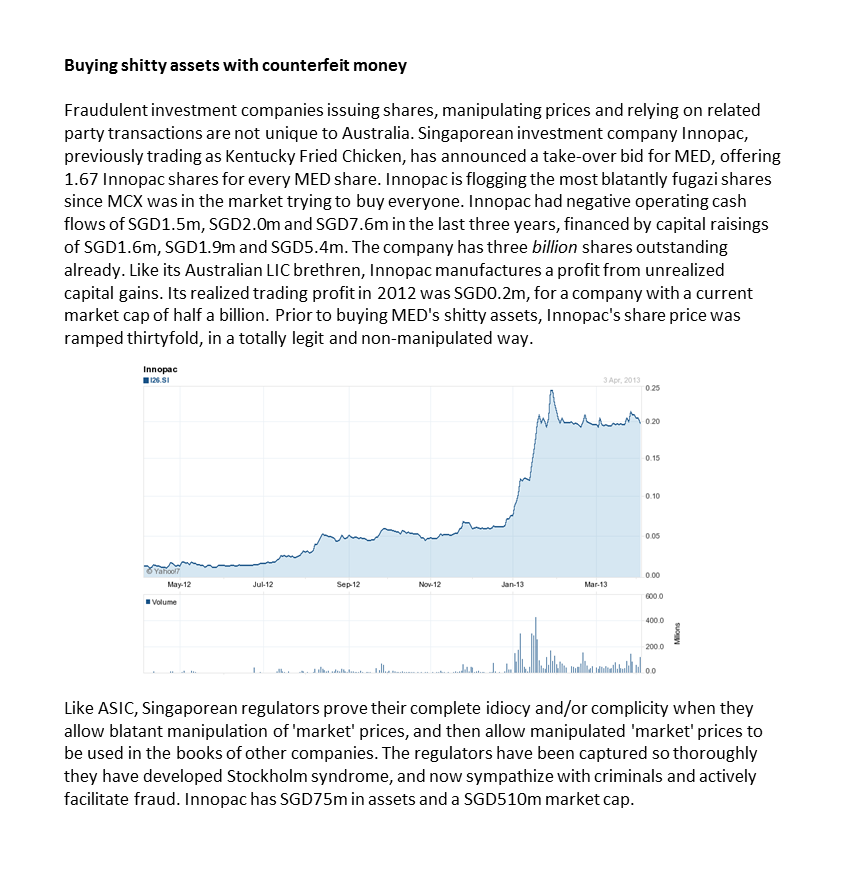
Australia is not the sole domain of listed investment company fraud and regulator complicity. In Singapore, a group of listed investment companies has formed a giant securities fraud cartel. Innopac (I26.SI), Blumont Group (A33.SI), IPCO (I11.SI), LionGold (A78.SI) and Asiasons (5ET.SI) engage in revaluation fraud and circular investment schemes. The cartel builds massive crossholdings, engages in fraudulent related party transactions, falsifies NTAs, and manipulates stock prices. After ramping its shares, Innopac made a bid for ASX-listed Merlin Diamonds (MED.AX), as this blog mentioned in April 2013.


Innopac and its accomplices deliberately ramped its share price far beyond asset backing. It is during such a ramp that granny investor money is stolen, not during the inevitable crash to fair value. In October 2013 the share prices of the Singapore listed investment scams collapsed, perhaps because they had been warned by the complicit regulator that their scam was getting embarrassingly obvious.


Just like its Australian counterparts, Singaporean regulators have made no attempt to prosecute the criminals, preferring to pretend the share ramps were inexplicable magical market mysteries instead of fraud. Singaporean regulators have de facto become accomplices to the criminals, covering their tracks and protecting them. Just like in Australia, there is no free press to expose the criminals. In both Singapore and Australia, the rich and powerful criminal operators of listed investment scams have subverted the system to the point where a small investor has zero recourse to the law. Now the first lawsuits from the scam have started arriving in Singapore and Britain.


In Australia, Blumont Group has stakes in Cokal (CKA.AX) and Celsius Coal (CLA.AX), and is being sued for reneging on an investment in Prospect Resources (PSC.AX).


To be entirely clear and specific here: Innopac, Blumont, IPCO, LionGold and Asiasons are criminal organizations, vehicles of securities fraud run by criminals that consider themselves above the law. Singaporean regulators are complicit morons and are protecting the criminals. The ramps were not magical market mysteries, they were fraud. Any investor that lost money due to the regulator's astounding incompetence and complicity can expect zero justice. But in the extremely unlikely scenario that the criminals one day face justice, the regulator accomplices should be lined up right next to them.

Saturday, 7 December 2013

Aha! Avestra and the "Formosa Auto Trade" scam

From humble origins, Avestra has recently stepped up to the big leagues of financial crime, having acquired and ramped listed funds manager AG Financial (AHA.AX), gaining control over its funds. Only three short years ago, Avestra was involved with the "Formosa Auto Trade" scam, handing out flyers selling magical laptops with auto-trading software. For only $15,950, you could buy the Formosa Premium One package, yielding $1,000 a month in profits, "no knowledge or effort required". But wait! For only $22,550, you could buy the Premium Plus package and take home $2,000 a month. However, the best deal of all was obviously the Turbo package, costing you only $29,700 upfront and yielding $5,000 a month.


The "Formosa Auto Trade" scam was advertised by Signal Systems and Support using the AFSL of Bold Capital, which was the authorised representative of Avestra Capital. The fraudsters spammed these flyers on stock discussion boards, complete with phony testimonials, receiving a fair share of heckling for their childishly transparent scam.

http://www.aussiestockforums.com/forums/showthread.php?t=21337
http://www.forexpeacearmy.com/forex-forum/scam-alerts-folder/13119-formosa-auto-trade-system-paycheck-autotrade-scam.html

ASIC does nothing about securities fraud because it is an absolute joke. ASIC legitimizes and enables career criminals that have been involved in scams going back decades.

http://www.smh.com.au/articles/2002/07/19/1026898914951.html

With ASIC's support and help, what was once a petty $30K-a-pop fraud has now grown into an ASX-listed fraud controlling dozens of millions of misappropriated granny investor funds. The walking bags of fecal matter at ASIC must be truly proud of their achievement here.

Friday, 6 December 2013

Avestra Asset Management launches new circular investment fraud

ASIC has for years done absolutely nothing to stop circular investment scams where associated funds "invest" in each other instead of investing in actual assets. As a result, such securities fraud is now endemic in the Australian funds industry, with new scams emerging daily. Avestra Asset Management recently launched yet another scam of this type. Avestra runs the managed funds Avestra Advantage, Canton Mackenzie and Worberg Global. Using money entrusted to these funds by gullible investors, Avestra took over listed funds manager Excela (EXA.AX), now renamed AG Financial (AHA.AX). After gaining control, Avestra had the managed funds Excela Maximiser and Emergent "invest" in Avestra Advantage and Worberg Global. This is blatant securities fraud, and would have led to arrests in other countries.

http://fundhost.com.au/investor/maximiser
http://fundhost.com.au/investor/emergent

Avestra Advantage and Worberg Global were issued AHA shares at $0.02. Avestra then ramped AHA to $0.04 in late June 2013 on no volume, artificially inflating the NTA of its funds. As a result of this revaluation fraud all Avestra funds now have fraudulent NTAs.


On semi-functional websites that look like they were designed by someone paid five dollars, perhaps a freelancer, Avestra funds claim to offer high returns, low volatility and capital growth. The claims of low volatility seem strange, given that Canton Mackenzie's NAV fell 16% in the single month of February 2013, as did Avestra Advantage. These funds have extremely suspicious returns. Worberg Global was ramped up around 50% in August 2012, while Avestra Advantage was ramped 28% in the same month.

http://www.worberg.com/newfund2/
http://www.avestra-advantage-fund.com/performance.php
http://www.cantonmackenzie.com/performance/

The funds have entirely fraudulent returns as they are circular investment scams. As long has Avestra has net investor inflows, its funds can claim any monthly return they want to. If Avestra's investors were to try and cash out, however, the inflated prices could not be maintained by the criminals, that reportedly have extensive experience in shady business deals and gender-bending.

http://www.smh.com.au/business/genderbender-of-a-tale-with-a-uranium-chaser-20090924-g4rs.html

Avestra only had to spend a few million dollars of other people's money to gain control over Excela's $22m in managed funds and plunder them. Excela's previous management sold its granny investors for a confidential amount to Avestra, according to page seven of its annual report.

http://www.asx.com.au/asxpdf/20131025/pdf/42kb3dbrl2t08c.pdf

ASIC will allow this fraud to continue until it blows up, at which point it will deny any responsibility. ASIC goes beyond incompetency here.

Thursday, 5 December 2013

Clime Capital (CAM.AX) reveals hidden crossholding fraud

Clime Investment Management (CIW.AX) manages Clime Capital (CAM.AX) as well as wholesale funds. CIW owns 7.82% of CAM, which is associated with WAM, which owns 20.82% of CIW. CAM is a listed investment scam paying dividends out of capital raisings, as management fees swallow most cash generated from assets, with the fair value of CAM but a fraction of its asset backing. The Clime fund empire is a circular investment scam, similar to that of van Eyk and Aurora.

CIW manages several listed and unlisted funds. Instead of purchasing actual assets with the money it was entrusted, CIW created internal crossholdings between its funds, and failed to disclose these holdings in substantial shareholder notices or related party disclosures. This is securities fraud. On 5 December 2013 CIW suddenly revealed a previously undisclosed stake in CAM held through its wholesale funds, bringing total ownership to 19.20% instead of the previously disclosed 7.82%.

http://www.asx.com.au/asxpdf/20131205/pdf/42lfgj1qngr3sz.pdf

In a country where the regulator was doing its job instead of bleating its magnificence, this fund scam would have led to arrests and fraud charges. CIW openly breached its fiduciary duty by diverting funds into crossholdings, doubledipping on fees and deliberately inflating its NTA. CIW purposefully moved investor money into crossholdings that have zero net value for investors but increase fees for CIW. The CIW funds that hold CAM are fraudulently overstating their NTAs at this moment. This is fraud, without any question.

CIW went so far as to deliberately try to hide its fraud in annual reports and other disclosure, yet still ASIC refuses to do anything. CIW still has not disclosed exactly when it started its internal crossholding fund fraud, nor at what price, nor how much unrealized profits and fees have been generated by the scam.

Biotech Capital (BTC.AX) loses 56% of its imaginary assets

Biotech Capital (BTC.AX) is yet another listed investment scam with book assets valued entirely according to the "opinions" of the operators. In its 30 October net tangible asset disclosure, BTC fraudulently claimed an NTA of $0.0416 based on director opinions, despite its auditor refusing to sign off on this entirely imaginary valuation in the annual report. In the November 30 NTA disclosure, BTC then announced a 56% downward revaluation of NTA to $0.0181, with its only remaining investment slashed to a third of its previously carried value. Any investor that based a purchasing decision on what was a blatantly fraudulent October NTA disclosure is simply out of luck, and shouldn't have expected such petty details as fund asset disclosures to be regulated in any way by ASIC. BTC currently has a "market" price of $0.025, according to ASIC due to an entirely inexplicable magical market mystery.

http://www.asx.com.au/asxpdf/20131101/pdf/42kl1k9ylcvqt0.pdf
http://www.asx.com.au/asxpdf/20131203/pdf/42lbxjtkmscc05.pdf

BTC now has book assets of $1.4m, with incumbent management extracting around $0.4m a year in cash from the remains of the failed company, obscured through deceptive accounting. The directors extract this $400K because they have control and can do so. BTC claims to be in wind-down and would thus appear to be approaching the end of the line. However, it is a very safe bet to assume the criminal operators of this scheme will miraculously find a great new opportunity for issuing shares to granny investors instead of closing up shop.

Just as BTC carried its investment in unlisted Sensear at a deliberately inflated value, so fund managers continue to carry BTC at values they well know are inflated. This is securities fraud, with inflated assets laundered through a chain of holdings. Select Asset Management currently holds 23% of BTC through a melange of funds, and carries its stake at an inflated "market" price, despite being well aware it could not actually sell its holding at that price.

In October, Select Asset Management claimed to have sold 3.5m shares of BTC for $734,469, for a sale price of $0.209, ten times the price that BTC traded on the ASX.

http://www.asx.com.au/asxpdf/20131022/pdf/42k6tqxmpc0dqj.pdf

This is either a typo that no one noticed because ASX disclosures are in effect unregulated, or another magical market mystery.

Monday, 2 December 2013

Australia China Holdings (AAK.AX) and its pear fund friends

Bermuda incorporated Australia China Holdings (AAK.AX) is yet another ASX-listed investment company featuring crossholdings and related party transactions, with several of its subsidiaries showing up as top twenty shareholders of the company. AAK claims operations in "trading, property investment, hotel management and other projects in environmental businesses", and has 3.5bn shares outstanding, the result of decades of share issues and ramps. These shares currently trade at a "market" price between $0.001-0.002, giving AAK a market cap up to $7m.


AAK offers Australian investors an opportunity usually only available from Nigerian princes. According to its latest annual report, AAK has assets of $73m in the form of a deposit paid on Mongolian farmland. Now AAK shareholders just need to pay another $1m in "registration fees", and they will own farmland worth $73m! (AAK's Malaysian auditor carefully qualified its opinion as to the "recoverability of the deposits", AAK's only asset.) This invaluable farmland has so far provided zero actual cash flow for AAK, despite AAK apparently having leased the farmland to the ungoogleable "Beijing Shuimu Zhongtian Institute of Horticulture Sciences" for $2m a year in 2011. In fact, AAK mysteriously had no operating cash inflows at all for the last five years.

http://www.asx.com.au/asxpdf/20130626/pdf/42gphzykt8dz7l.pdf

That's OK though, because operating cash flows are not necessary for securities fraud. AAK has an ASX-listing and sports a "market" value endorsed by ASIC, and this in and of itself gives AAK utility for revaluation fraud. In December AAK announced it has forged a strategic agreement with an unnamed Chinese investment group with strong backing from "pear fund managers" (sic), to issue more shares.

http://www.asx.com.au/asxpdf/20131202/pdf/42l9x9vzm72c3x.pdf

The unnamed investment group and AAK will obtain financing, invest in each other, and place shares together. The related party is about to start again, with ASIC proudly chaperoning.

Thursday, 28 November 2013

The canker: new revaluation frauds launched

If corruption and crime is allowed to fester unchecked, by its very nature it will spread. For years ASIC has allowed revaluation fraud and share ramping in the Australian market. As a result, new investment companies engaging in revaluation fraud are now sprouting like mushrooms on the ASX, with every failed and chronically loss-making entity imaginable starting anew as an LIC. After all, it is much easier to manufacture imaginary unrealized profit than it is to generate real cash profit. The new investment companies all follow the same modus operandi; they buy (often related party) assets, revalue these upward, ramp the investment company share price, and then issue shares to granny investors based on its great new "assets" and "profits".

Australasian Wealth Investments (AWK.AX) is a new listed investment scam created from the shell of MEF.AX, which in turn sprung from FAT.AX. During its phoenixing, it performed a series of sham transactions between related parties, and acquired a 50% stake in unlisted van Eyk research, which it can now revalue at will. AWK's most recently reported net tangible asset backing was $0.3753. AWK is issuing 38m shares at $0.3705, increasing shares outstanding by two thirds. AWK's share price was then ramped to $0.495 by the scheme's operators and accomplices, allowing them to book unrealized profits in excess of 30% in a matter of weeks.


Ramping AWK to $0.495 allows Contango Asset Management (CTN.AX) and Leyland Asset Management to fraudulently book unrealized profits in excess of 30% on their holdings of AWK. CTN pays real cash fees to its management based on such fraudulent unrealized "profits", and issues CTN shares to granny investors based on books with inflated assets. Of course, according to ASIC, when a revaluation fraud ramp occurs, it is not a ramp at all, but rather a magical market mystery.

Allied Consolidated (ABQ.AX) is another new revaluation fraud. Recently called Allied Brands, perennially loss-making ABQ is now changing name again, to Disruptive Investment Group, like children painting stripes on a car to make it go faster. ABQ has bought a failed internet business for $35,000, which it can revalue at will. At its general meeting ABQ resolved to issue 120,000,000 shares at $0.0025, issue 190,000,000 shares at $0.01, issue 60,000,000 options at $0.000025, and issue 20,000,000 shares to previous noteholders, with sundry allotments to directors. ABQ's price was then ramped to trade around $0.03.


The shenanigans at ABQ was too much even for the auditor to unflinchingly stomach, with the auditor making a "disclaimer of auditor's opinion" in the 2013 annual report and refusing to sign off that ABQ is compliant with the Corporations Act.


Meanwhile, ASIC is giving its guarantee that ABQ is not ramped and manipulated, just like it does for every single revaluation fraud. For if ABQ were ramped and manipulated, ASIC would have to do something about it.

Wednesday, 27 November 2013

A scam is but an investment with comprehensive management fees

US Masters Residential Property Fund (URF.AX) is a scam run by Dixon Advisory. The fund claims to invest in high-yielding American property, purportedly using collected rental income to pay steady high dividends to granny investors. In reality, URF is a ponzi that pays its dividends out of capital raisings. The operators of this scheme manipulate URF's share price while gutting the fund with various hidden fees and related party transactions. URF's half-year report for the six months to June 2013 brazenly describes ongoing securities fraud.

http://www.asx.com.au/asxpdf/20130828/pdf/42hzwfpnj35qh0.pdf

In the six months to June 2013, URF had investment property rental income of $4.4m, with rental expenses of $2.5m, for net rental income of $1.9m. From this $1.9m income, the scheme operators charged fees exceeding $10m:

  • Dixon  is entitled to an annual Responsible Entity Fee of 0.55% of the fund's gross asset value, charging $460,958 in HY13.
  • Dixon is entitled to an annual Investment Management Fee of 2% of the fund's gross asset value, charging $1,057,751 in HY13.
  • Dixon is entitled to a Leasing Fee of 3 months gross rent on new leases, charging $499,987 in HY13.
  • Dixon  is entitled to an Asset Acquisition Fee of 1.99% of the purchase price of assets acquired, charging $1,816,728 in HY13.
  • Dixon is entitled to a Structuring and Handling Fee of 2% of total funds raised, charging $2,947,774 in HY13.
  • Dixon is entitled to a Debt Arranging Fee of 2% of the gross amount of borrowings obtained, charging $614,872 in HY13.
  • Dixon is entitled to on-charge "administrative expenses", charging $3,042,028 in HY13.

These are but a subset of the fees charged by Dixon and related parties. Of these $10.4m in fees, only $1.7m was recognized as management fees in the profit & loss statement, with the rest obscured by fraudulent accounting and deceptively hidden in report footnotes. URF also paid out distributions to unitholders totalling $10.4m. All this was made possible by issuing shares worth $74m. What has just been described is not a viable business plan, it is a ponzi.

If URF shares were to trade freely they would have collapsed in value. Instead, Dixon and accomplices completely control URF's share price, and have ramped the price above reported NTA. URF does not trade at a "market" price, its price is fixed by the scheme operators. ASIC refuses to take any action, instead protecting the criminals. According to ASIC, the URF ramp is a magical market mystery, and not fraud. Dixon would never have been able to commit its crimes if not for the facilitation and legitimization from ASIC, its most valuable partner.


On 28 August 2013 a partner at Deloitte signed off on URF's half-year report, thereby becoming an accomplice to Dixon's securities fraud. From the accounts the auditor would have been perfectly aware of the fraudulence of the scheme, or should have been in any case, yet the scum still signed off on it. The partner did this safe in the knowledge he will never face prosecution for his role in this scam, never have to face any consequences for his crime.

Monday, 25 November 2013

Big fish eat little fish

The fair value of a listed investment company as a going concern is always lower than its liquidation value, since ongoing management costs burn a proportion of the cash generated by assets. This means that smaller LICs are vulnerable to predation by bigger LICs, by nature, if they allow their shares to trade at fair value. To avoid predation, LICs ramp their "market" prices above fair value, form crossholdings with accomplices, and entrench various poison pill measures designed to make it costly or impossible to wrench incumbent management away from the fee frenzy. Shrinking funds are especially susceptible to change of control, with the aggressor LIC not interested in the target's assets, but looking to take over the target's granny investors. A sharemarket listing provides legitimacy, allows the charade of a "market" price, and crucially, allows the investment company to issue inflated shares to granny investors.


The latest "new" Australian listed investment scam and revaluation fraud is Thorney Opportunities (TOP.AX), formerly Wentworth Holdings (WWM.AX), due to issue millions of shares at a purposefully inflated price. Thorney has ensconced its position with an openly exploitative management agreement that gives it 1.5% of gross assets annually and 20% of any increase in net asset value. The "independent expert" hired by Thorney calculated that the takeover would immediately destroy a quarter of shareholder value for non-associates ($0.525 before versus $0.409 after takeover). The "expert" then astoundingly concluded this was "not fair but reasonable", which seems like a perplexing conclusion, until you remember this is what the expert was paid to do.


Thorney and its criminal associates currently control the share price of WWM. WWM had an October 2013 net asset backing of $0.45, and is issuing millions of shares at $0.50, yet its current share price mysteriously has shot up to $0.68, in what ASIC guarantees to be a normal market movement and not a deliberate ramp. The true reason is not magic, however, it is fraud. The reason that WWM now trades at 50% above its latest reported NTA is that it has become a vehicle for securities fraud, with a completely manipulated "market" price.

Thursday, 21 November 2013

van Eyk funds "invest" in each other

van Eyk funds are engaged in revaluation fraud, using crossholdings and circular trading to artificially inflate assets. Listed van Eyk Blueprint Alternatives Plus (VBP.AX) feeds money into unlisted van Eyk funds that it can revalue at will. Various van Eyk funds then divert funds back into VBP. VBP is a circular investment scheme, a ponzi that pays dividends depending on how many units it can issue. In countries governed by the rule of law, VBP's circular investment scheme would already have led to fraud charges. ASIC has flatly refused to take any action whatsoever. van Eyk's fund empire deliberately overstates its assets by millions of dollars using internal crossholdings, by having its listed and unlisted funds fraudulently "invest" in each other.
 
According to its 2013 cash flow statement, VBP received $2.6m in dividends and interest from its related party "assets", with entirely reasonable and sustainable management expenses of $5.6m. VBP then paid $16m in distributions, made possible by $19m net inflows from unitholder applications.

http://www.asx.com.au/asxpdf/20130930/pdf/42jqdtc9kmrnw7.pdf

According to its annual report, VBP had total assets of $275m in 2013, $68m of which mysteriously consisted of receivables from brokers for securities sold, with $168m in the unlisted van Eyk Blueprint Alternatives Plus fund. These "assets" conspicuously fail to generate cashflows, which does not deter "investors" from buying VBP. The top 20 shareholders of VBP include funds such as van Eyk Blueprint Balance, van Eyk Blueprint High Growth and van Eyk Blueprint Capital Stable. This is open fraud, only possible because of ASIC's ongoing gross negligence and incompetence.

Aurora funds management is the responsible entity for VBP, acting as van Eyk's accomplice in this circular investment scam, but has lately started to distance itself from van Eyk. Following those noises, on 21 November Aurora tersely announced a meeting for unitholders to consider the replacement of Aurora as responsible entity.

http://www.asx.com.au/asxpdf/20131121/pdf/42l0lf8lc10sq0.pdf

Meanwhile, ASIC maintains its sphincter-like silence.

Wednesday, 20 November 2013

CDM comes bearing "bonus options"

The success of a listed investment company is predicated on its success at issuing shares. Operating performance is utterly irrelevant and can be misrepresented at will. ASIC doesn't even bother maintaining a semblance of regulation of NTA disclosures, allowing funds to materially overstate assets and commit revaluation fraud with related parties. Since share issuing and asset misrepresentation is the life-blood and raison d'être of fraudulent investment companies, they continually invent new ways to issue shares and misrepresent assets. Having already quadrupled shares outstanding in 2013, Cadence Capital (CDM.AX) announced it had "resolved" to issue "bonus options" to its granny investors in January 2014.

http://www.asx.com.au/asxpdf/20131114/pdf/42kvn7ngr1lcws.pdf

Any value the option will have to shareholders will be taken directly from the shareholders themselves. The bonus options are a "free" gift to shareholders, from shareholders, with zero net value for shareholders. Given administrative costs, the "bonus option" offer is objectively of net negative value to shareholders, a scheme only benefiting management hoping to issue shares, and a clear breach of  fiduciary duty. In net tangible asset disclosure documents, CDM now fraudulently claim these "bonus options" have a value of $0.075-$0.11 to shareholders, hoping to fool granny investors that expect such disclosure documents to be regulated. CDM management has conjured $0.075-$0.11 per share out of thin air, using the magic of accounting fraud.

http://www.asx.com.au/asxpdf/20131118/pdf/42kxzmp1nzqxqs.pdf

This net tangible asset disclosure is blatantly and intentionally fraudulent, and lodging it was a criminal act. It is an indictment on ASIC that it does absolutely nothing when funds deliberately falsify the most basic metric of all.

GFL, FSI and the crossholding buyback scam

Associated investment companies Global Masters Fund (GFL.AX) and Flagship Investments (FSI.AX) are part of a cartel engaged in revaluation fraud, in the form of the crossholding buyback scam. Like all investment companies, GFL and FSI pay exceedingly real fees to management based on unrealized profits, "profits" that in most cases are never subsequently realized. By using crossholdings and buybacks, related parties can artificially inflate assets, "profits" and fees.
 
A director's private company owns 56% of GFL and 28% of FSI. GFL has reported net assets of $10m, 28% of which was diverted to buy shares in FSI, distorting reported NTA and allowing directors to doubledip fees. After this "investment" by GFL, FSI ramped its illiquid share price with buybacks, creating illusory profits on GFLs holding. By funneling funds from GFL into FSI, in order to benefit themselves at the expense of small investors, the directors have breached their fiduciary duty. By deliberately misrepresenting their funds' assets and profits they have committed securities fraud.

FSI receives $1.5m dividends annually from its assets annually, with costs anywhere between 28% and 100% of cash inflow, mainly due to rapacious management fees. GFL has expenses in excess of revenues. The share prices of these companies have nevertheless been manipulated to par with NTA, far above fair value, with ASIC's blessing.


Monday, 18 November 2013

In remission: USH patiently waits

Directors of failed listed investment companies sometimes promise to "consider" giving back the funds they have gained control over and are taking fees out of. Unsurprisingly, such promises are never kept, as some great new "opportunity" always emerges, prompting the directors to instead raise even more capital. If the company fails so spectacularly that new sucker investors cannot be found, there are several options, the easiest of which is to just walk away from the smoldering wreck and start a new fund. Another option is to rename and recapitalize the company with accomplices, using fake transactions between the related parties to inflate the valuation of remaining assets, as in the case of Australasian Wealth Investments (AWK.AX). Sometimes failed investment companies are hibernated as the directors wait for the right time to resume share issuing. One such carbon-frozen company is U.S. Masters Holdings Limited (USH.AX).

USH is a dormant listed securities fraud incorporated in the British Virgin Islands. According to its latest NTA disclosure USH has net assets of $255,000, or $0.011 per share, largely held as cash. The last traded price for USH was $0.20, or 18 times current asset backing, and this is the price USH advertises as the current ASX "market" price on its website. USH has not traded on the ASX since 2012 and is currently bidless. In its 2013 annual report USH reports $25,000 in revenue and $729,000 in expenses, with cash decreasing by $607,000. Auditor Ernst & Young nevertheless unreservedly endorsed the annual report, with no going concern qualification. Because why not? It's not like they will be held to account by anyone.

Friday, 15 November 2013

Freelancer: priced for perversion

Freelancer (FLN.AX) listed on the ASX today, after an IPO of less than 7% of the company, with 30m shares offered at $0.50. Directors hold 87% of the 436m shares outstanding, with the top 20 shareholders owning 96%. Of the $15m cash raised, $1.25m was paid to a director's company for "various domain names" and $1m was spent in offer costs. $2.5m was doled out in non-recourse loans for directors and employees to buy employee shares. FLN opened at $2.50, pricing the company at $1.1bn, for a forecast 2013 price earnings multiple of 2,300. After peaking at $2.60 in the obligatory initial ramp, FLN's "market" price then fell as much as 45% in intraday trading, before closing at a $1.60.
 
These facts would seem enough to deter any sane person from investing in FLN. But in today's bizarre world this market perversion is regarded not only as entirely normal, but as a very positive start to a great investment for long term buy-and-hold granny investors. The broker of the IPO was KTM Capital, who previously had managed capital raisings for poisoned chalices Datadot (DDT.AX) and Antaria (ANO.AX). The share prices of DDT and ANO naturally follow the by-now familiar pattern of long term shareholder value destruction interspersed with temporary ramps.


In the case of Datadot, KTM got a wrist-slap from the Takeovers Panel for a fraudulent scheme to benefit insiders, with its conduct declared unacceptable and misleading. 

http://www.takeovers.gov.au/content/DisplayDoc.aspx?doc=reasons_for_decisions/2009/013.htm&doctype

So do as the co-opted media tells you, don't dig too deeply researching or thinking, just throw caution to the wind and buy all these great shares that are being shilled.

Thursday, 14 November 2013

CYA pays greenmail to WAM

Century Australia Investments (CYA.AX) announced a share buyback on 14 November, purportedly for "capital management" purposes. In reality, the buyback is greenmail to WAM, which built up a 21% holding in CYA and threatened to oust current management. CYA's porcine management announced the buyback to keep their snouts firmly in the fee trough. CYA's "market" price had been moved to par with NTA prior to the announcement, and fixed at $0.89.


In the preceding month WAM increased its CYA holding by close to a million shares, in preparation for demanding greenmail, so that it could sell back some of its CYA shares at the ramped price, and keep the rest of its holding valued at this artificial price. The communications between WAM and CYA regarding this scam is material information for their granny investors. When CYA's criminal management lied to its investors about the reason for the buyback, they committed securities fraud.

Listed investment companies are the Drosophila of financial fraud research, as they can be straightforwardly analyzed and valued. CYA holds listed assets with a current value of around $70m, or $0.89 per share. CYA collects interest and dividends of around $3m from these assets yearly, with around $0.8m in costs, or 27%. The fair value of CYA as a going concern is thus 73% of NTA, i.e. $0.65 per share, while its liquidation value is $0.89 per share. CYA promised years ago to liquidate the fund and return the money to investors, but never actually intended to, since that would stop the fee party.

The criminals running these companies know all this very well, but lie and dissemble, claiming that no matter the costs of an LIC, its ongoing fair value is at NTA or above. This is of course ridiculous, since quite obviously an LIC with lower costs would be worth more to an investor than an otherwise identical LIC with higher costs. CYA ridiculously claims costs of 1.1%, dividing expenses by outstanding assets, yielding a deliberately deceptive and useless metric favored by fund fraudsters. The entire business model of the LICs depends on such dissembling, as they could never function if they had to issue shares at fair value.

Tuesday, 12 November 2013

Aquaint and Mariner launch new listed securities fraud

Newly ASX-listed Aquaint Capital (AQU.AX) is a Singaporean-Malaysian "property seminar" company involved in various loans to, investments in and revaluations of related parties. AQU raised $3m from offering 5m shares at $0.60, constituting 5% of shares on issue, with issue costs absorbing $1m of funds raised. Not a single share of AQU has traded on the ASX since its November 11 listing, yet now AQU can claim a "market" value of $62m, with ASIC's stamp of approval. With a standing bid for $0.65, AQU can actually claim a "market" value of $68m, legitimized and validated by Australian regulators. This stamp of approval is invaluable for seeking new sucker investors.
 
AQU has acquired an Australian financial services licence from a Mariner subsidiary, and several of the Mariner crew are now discreetly involved with Aquaint. Given Mariner's consistent record in almost complete destruction of investor funds, with MCX losing 99.9% of its value and counting, their discretion is perhaps understandable. Perhaps Aquaint can now perform some related party transactions with MCX's newly "revalued" retirement home business.

AQU's assets comprise of a maze of failing property loans and investments with related parties in several different countries, that it can value largely at will. AQU's prospectus reveals that even using its own "valuation techniques", many of its "investments" have a current value below the loans attached to them, and have not yielded promised returns. But AQU is not about generating any actual returns from its investments, it is in the business of revaluing related party assets upward and issuing shares, taking fees at every level.

Shown below is the structure of AQU's Indian properties, sold to its property seminar punters and now packaged into AQU shares. Although AQU owns 82.9% of Bria East Asia Fund, it claims to not control it.


Monday, 11 November 2013

Clean Seas Tuna goes fishing for granny investor cash

Failed fish farmer Clean Seas Tuna (CSS.AX) is issuing yet more shares, following an endless series of capital injections and consistently loss-making operations. In the days prior to the announcement of its latest October capital raising, which CSS purports to base on a "market" price, CSS sharply ramped its share price with the aid of accomplices. CSS naturally pulled the usual "aw chucks no idea" routine when queried by ASX, as it always does. 

CSS is currently maintaining its price at $0.04 during the share offer, which entirely coincidentally would price the share raising at its maximum of $0.032. The capital raising squarely targets granny investors, offering a fraudulent 20% discount to the "market" price for investments up to $15,000. CSS will have 987,000,000 shares outstanding, and follows the standard pattern of long term decline interspersed with ramps. The corrupt directors of the CSS fiefdom also hire relatives and dish out extra "consulting" fees, as noblesse oblige.

Sunday, 10 November 2013

ASIC vouches that Goconnect is not ramped

Goconnect (GCN.AX) is a zany company with a billion shares outstanding and a consistent string of losses every year. Having formed a partnership with the Jackson family, GCN has abandoned any semblance of sanity. Its 2013 annual report humorously reports operating losses of $2m, net current liabilities of $4m, and $915 cash in the bank. GCN now plans to raise more money using the Jackson name, to build hotels and run reality shows in China.

http://www.asx.com.au/asxpdf/20131001/pdf/42jqzg949c22qq.pdf

GCN suddenly ramped its share price 250% in a few days in October, doing what it does best, namely issuing and ramping shares. GCN follows the familiar pattern of manipulated ASX companies, the interminable jolty downward ride. As always, ASIC pretends to notice none of this, and in effect fully supports GCN's and other companies' right to commit securities fraud, protecting the criminals by its refusal to take any action.


Saturday, 9 November 2013

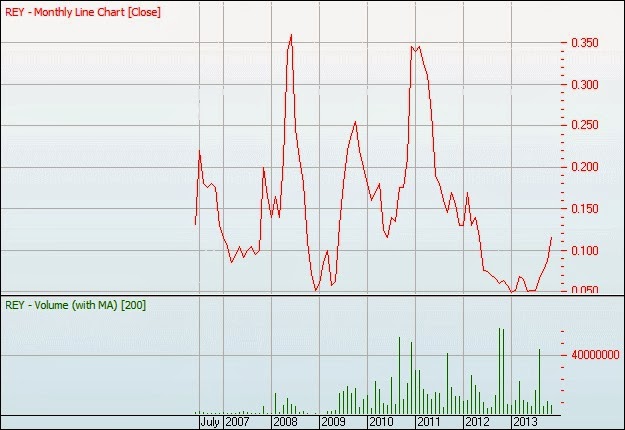
Rey finds a "cornerstone investor"

Rey Resources (REY.AX) is one of the major holdings of AFA. On 29 October 2013, REY issued $71m shares at around $0.06 to new "cornerstone investor" Crystal Yield Investments, further increasing the proportion of shares controlled by top twenty shareholders. Before taking up this 19.9% block of shares, Crystal Yield transferred its existing 9.8% ownership in Rey to parent company Ricky Holdings, because reasons. To celebrate, the price was ramped to $0.125 in early November, allowing the "cornerstone investor" an immediate unrealized "profit" in excess of $4m on its "investment", and prompting ASX to send one its price query charade letters. REY's share price, volatile even by mining exploration company standards, follows the standard pattern of long term shareholder value destruction interspersed with temporary ramps to benefit insiders.